“Write to think.” How Anne Whitesell turns writing into a tool for civic engagement.
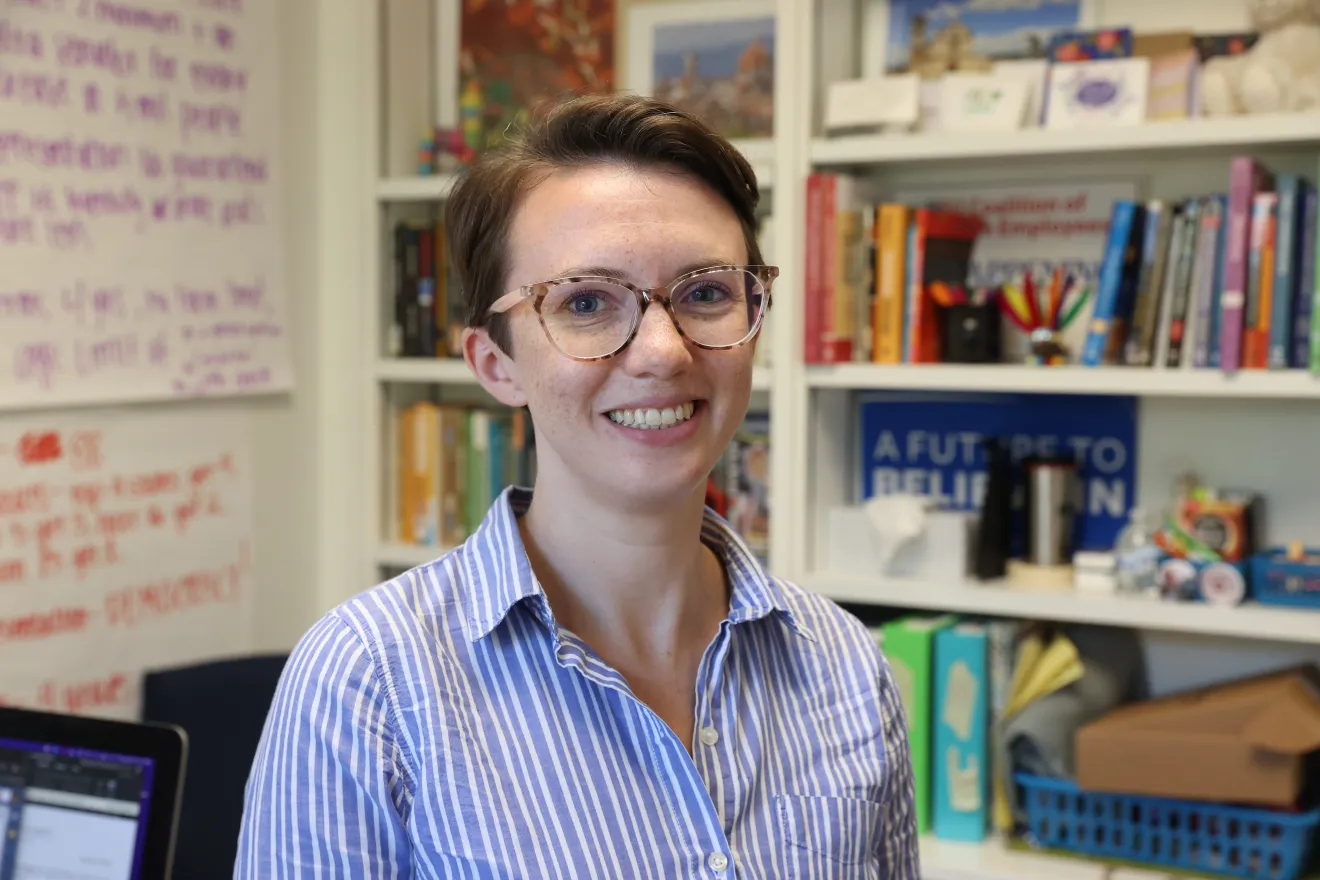
Anne Whitesell, an associate professor in the Department of Political Science, wants to help her students use the skills they learn in her classes to make change in the world.
“You can teach students how to write for different audiences and teach them political science content at the same time,” she says. “In American democracy, as an individual, you have the power and opportunity to use your voice and express your opinions, and you can do that through writing.”
Scrapping the Term Paper: Writing for Public-Facing Audiences
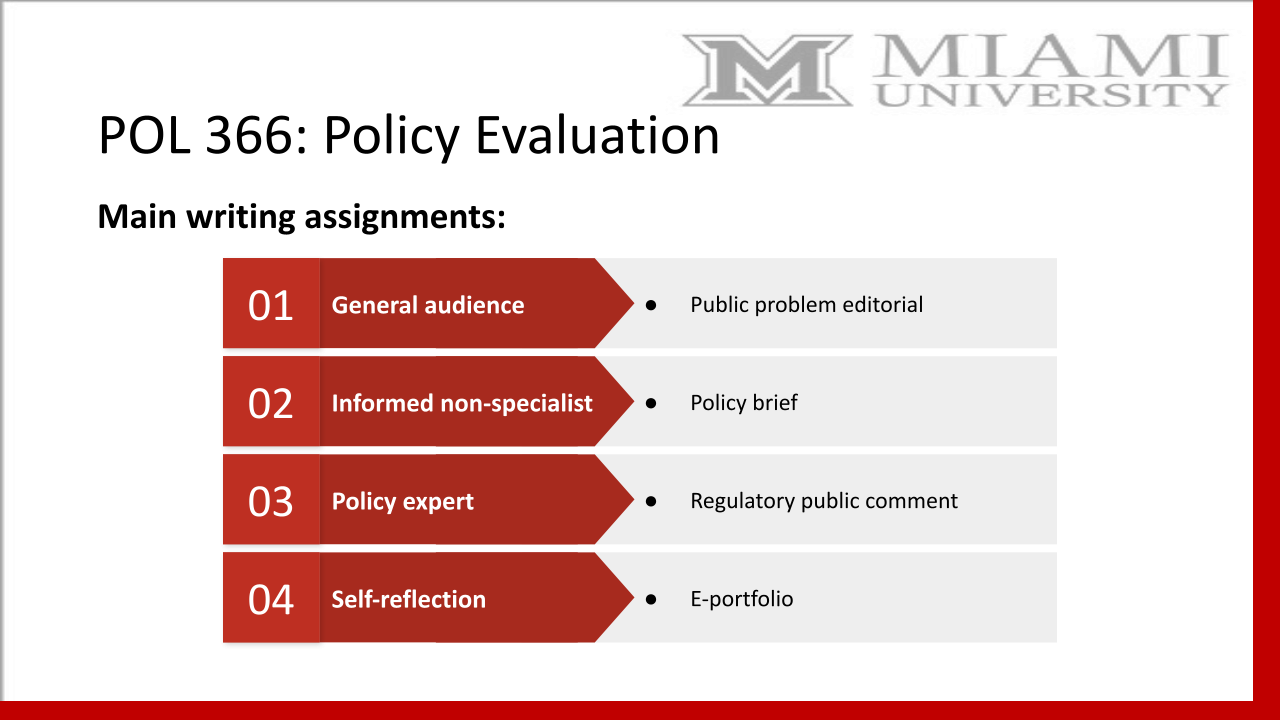
Her approach to teaching Policy Evaluation (POL 366), an advanced writing course in the political science program, emphasizes public-facing genres and their diverse audiences. Rather than assigning a traditional research paper, she engages political science students in the kinds of writing they will actually use in their careers and civic lives.
Whitesell creates the entry point into a deeper policy discussion through op-eds. “Policy affects everybody,” she says. “In the course we work from writing for people who know nothing about policy, which in theory is some of the students, to writing for policy experts. And so we purposefully start with an op-ed.”
By starting with this genre, students naturally choose a topic that is important to them. The op-ed represents a chance to express their deeply held ideas to a broad and general audience, and is a mode of writing that holds real utility in their future. Whitesell says, “I want students to be able to write a strong letter to their member of Congress, or an op-ed about something they believe in.”
In drafting their op-ed, students are encouraged to use their own voice. Whitesell then connects this to other more formal genres, such as responding to proposed federal regulations. While it might seem that this kind of wonkish policy discussion starkly contrasts with the public-facing genre of the op-ed, she points out the common thread: “Both are ways that you are expressing your opinion about what's happening in the world and asserting influence, whether you're influencing the public or the bureaucracy.”
This layered approach to the different genres of policy writing has its roots in Whitesell’s own collegiate education. As an undergraduate, Whitesell’s perspective shifted after experiencing a course designed with intentional scaffolding. The method's effectiveness left a lasting impression. “Once you see it, you can’t unsee it,” she said, recalling how she began to question why the approach wasn't standard practice across all her courses.
Subsequently when she began to design her own courses, she asked herself, “Why am I asking students to write a research paper? This is a genre that they’re never going to use.”
Course Redesign: Engaging Student Writers
In spring 2023, Whitesell joined the Howe Faculty Writing Fellows Program after university-wide general education updates prompted the Department of Political Science to rethink how its majors fulfill advanced writing requirements. The Howe Faculty Writing Fellows Program supports faculty members and their departments in their efforts to teach students to write more effectively in their disciplines and professions and to use writing in ways that encourage deep learning of disciplinary material. Fellows offered the opportunity to reimagine her approach to the course.
“While I had a lot of writing incorporated into my classes, it wasn't until I was part of Fellows that I could really name what I was doing,” she says. “Fellows gave me the language of writing to learn and learning to write.”
As part of the Fellows process, Whitesell created a set of goals that she then scaffolded into the course:
- Create writing assignments for different audiences
- Expand opportunities for student self-reflection
- Make expectations explicit
- Incorporate institutional advanced writing outcomes into the course curriculum
In her final presentation for Fellows in 2023, she demonstrated her vision of how these goals could be deployed through the semester, moving through a progression of writing for different audiences and then culminating in a course-based ePortfolio.
Subsequently, beginning in spring 2024, Whitesell conducted pre- and post-classroom surveys to measure her students' learning gains, finding that students reported increased confidence in their writing and a better understanding of the genres and audiences in policy writing.
“They become experts because they've been writing about it all semester,” Whitesell explains. “I've had students use those policy briefs as writing samples for job applications. Another student met with people in Cincinnati to discuss her affordable housing proposals. It’s not me prescribing a topic, but finding something they care about and then asking them to write about it.”
In April 2026, Whitesell published an article in the Journal of Political Science Education on the process of redesigning Policy Evaluation to incorporate writing for a variety of audiences. The article, “Increasing Civic and Career Preparedness through Policy Writing,” connects the kind of work students do in her class to their future careers, arguing that her structured approach to audience-centered policy writing equips students with both marketable professional skills and the tools needed for active democratic participation.
Though the article is published in a disciplinary education journal, Whitesell hosts the practical classroom tools—including the full course syllabus, ePortfolio rubric, and survey instrument—freely on her website for colleagues looking to adapt the framework.
Modeling Feedback Practices and Writing Processes
Scaffolding is a process that works well for Whitesell in her own writing. She regularly devotes several hours a week to the practice through the Faculty Writing Hours offered by the Howe Center.
“I try to have one project I work on throughout the semester,” says Whitesell. “Every week you set your goals—one week I’m working on the literature review, the next I’m writing the methods. It’s kind of amazing that just from going to Friday writing hours, I can finish a conference paper in eight weeks. It’s taught me that you can’t rush it in two weeks, but if you give yourself those two hours every Friday for eight weeks, you get it done.”
A key feature of the writing hours is regular reflection, guided by a progress log. Participants can look back through their work over the course of the semester and identify their real, measurable progress. This kind of reflective practice operates similarly to the ePortfolios Whitesell uses in her classes. The technique makes their accomplishments visible across time and provides accountability. “It's always fun to read the ePortfolio reflections,” she says. “You get to see them realize the scope of their own evolution on a topic.”
|
Goal Setting |
Goal Reflection |
|
I have a journal manuscript almost ready to send out for review. I need to read over what my co-author has added and fill in any gaps. |
I read through what my co-authors have added and made some small corrections. We need to clean up the discussion section, write a conclusion, and fix some of the references and then we should be good to go! |
Example of a progress log entry from Howe Center Writing Hours
As an undergraduate working with faculty on their research, Whitesell found it formative to discover that the writing process can be fraught, even for those who write professionally. “It’s important to show students that even for someone who has an advanced degree in a subject, writing doesn’t come out polished,” she says. “Lots of revisions happen and sometimes it’s very messy.”
Whitesell deliberately demystifies her own scholarly work in the classroom. She shares drafts and feedback that she receives from peers, encouraging students to view peer critiques as an essential dialogue between writers working through complex ideas.
By sharing and modeling her process, Whitesell builds empathy with students. Her goal is to show that there can be many different ways to approach the writing process, but the common denominator is that it requires sustained effort over time.
“Students are often hesitant to present something that isn't fully polished,” Whitesell explains. “Writing helps them move past that self-consciousness and build the confidence they need as developing professionals.”
Howe Writing Across the Curriculum Programs
The mission of the Howe Writing Across the Curriculum Programs is to ensure that all Miami faculty and graduate teaching assistants can effectively include writing as a means to support learning in their courses and programs.
Contact Us
151 S. Campus Ave
King Library
Oxford, OH 45056
hcwe@MiamiOH.edu
513-529-6100




2022 Writing Program Certificate of Excellence
2022 Exemplary Enduring WAC Program