
New Talon cluster a major leap forward in accelerated computing, AI technology infrastructure at Miami
The Western Geothermal Plant serves to cool the new servers and containment area, and reuse the excess heat
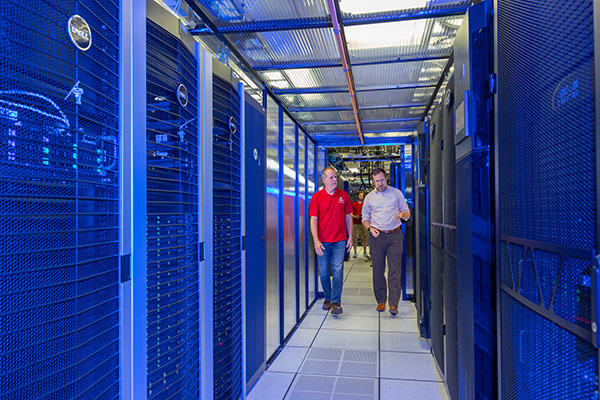
New Talon cluster a major leap forward in accelerated computing, AI technology infrastructure at Miami
The Western Geothermal Plant serves to cool the new servers and containment area, and reuse the excess heat
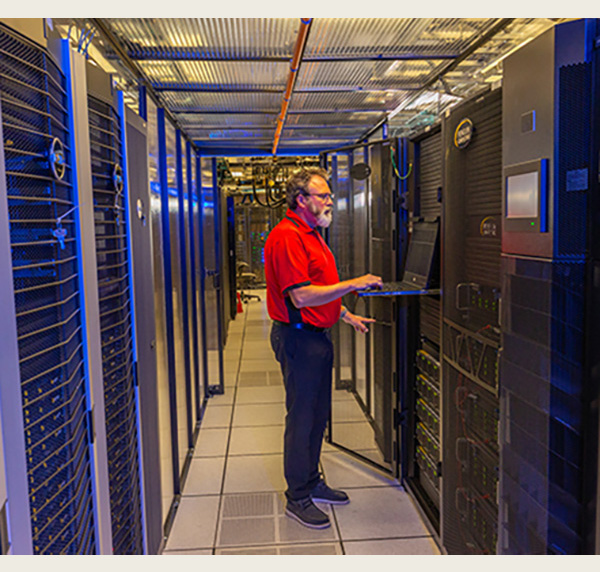
The Talon cluster is a dedicated high-performance computing cluster comprising multiple nodes, each with multiple state-of-the-art GPUs. Talon is in its final commissioning stages and is expected to be turned over for use by Miami’s research community at the end of June, Seidl said.
Research enabled by the Talon cluster spans all academic divisions at Miami. Some examples include the development of sophisticated simulations of atomic nuclei; the development and use of AI chatbots for complex technical handbooks; in silico screening of enzyme inhibitor candidates via machine learning; and the development of machine learning algorithms for automated analysis of image-based manufacturing quality control.
Students in Miami’s brand new B.S. in Artificial Intelligence program, and those in the new B.S. in Quantum Computing — the first of its kind for an Ohio institution — will have opportunities for learning in hands-on scenarios with the Talon cluster.
This new technology infrastructure was supported by a $494,000 National Science Foundation Campus Cyberinfrastructure grant received in 2024.
The project was led by principal investigator Rick Page, associate vice president for research and innovation, and co-principal investigators Seidl, Jens Mueller, director of High Performance Computing Services, and Scott Campbell, senior director of technology.
The Talon Cluster
The Talon Cluster includes four GPU nodes, each of which contains four Nvidia H100 GPUs and 20 high-density compute nodes.
Unlike central processing unit (CPU) clusters, GPU clusters utilize parallel processing, making them exponentially faster than a traditional CPU cluster to process huge amounts of data for AI training, machine learning, and deep data analytics.
To help cool the equipment — most of the electricity consumed by GPUs is converted directly to heat — a new containment area was built within the IT Services data center in Hoyt Hall.
The containment area — dubbed the Bird Cage — is large enough for the new equipment, the existing Redhawk HPC cluster, new cooling units, and expansion space for future equipment and additional cooling units, according to Mike Ritcher, manager of network infrastructure services.
Ritcher oversaw the construction and implementation of the new cooling system and server racks.
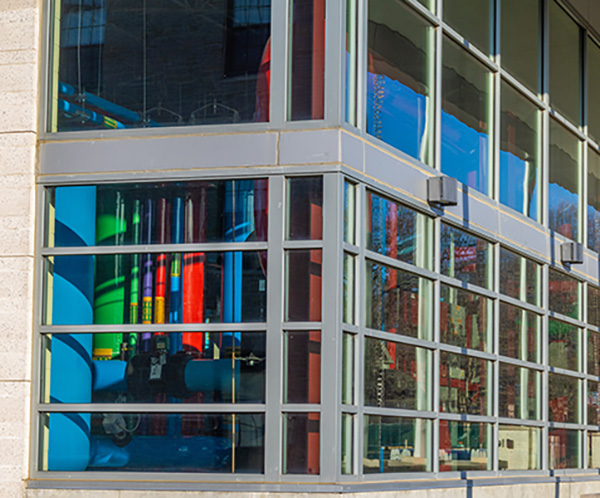
Cooling the Bird Cage with geothermal exchange
The new cooling system in the Bird Cage uses chilled water from the Western Geothermal Plant very efficiently, said Cody Powell, vice president of facility planning and operations.
It is designed to “optimize and physically separate the cold supply air from the hot exhaust air,” Ritcher said.
The chilled water is pumped through the data center and circulates under the raised floor of the Bird Cage containment area.
The servers are cooled by chilled water moving through the in-row cooling units.
The Talon cluster can generate up to 98,136 Btu max heat output, according to Seidl. That extra heat is transferred as heated water back to the Western Geothermal Plant and as warm air exhausted back into the larger data center.
Where does the extra heat go?
The heat collected from the Bird Cage and returning to the geothermal plant is used in different ways, Powell explained.
- In one mode, the heat is returned to the chiller to ensure there is a high "delta T" or temperature difference. The chillers operate most efficiently when there is a larger temperature difference (or delta T) because the return water is consistently warmer.
- When the conditions are such that the campus needs the heat, the hotter return water is used to provide that heat rather than using a natural gas boiler to generate it. This is simultaneous heating and cooling.
- If the campus isn't consuming this heat through simultaneous heating and cooling and there is more heat returning back to the plant than is needed to create the most efficient delta T, the heat is shifted to the Western Geothermal Wellfield and stored in the earth until we need to draw the heat back out.