
Purifying submarine air with light, chemistry, and student innovation
Professor Catherine Almquist and her RedHawk researchers aim to efficiently protect submarine personnel from gaseous containments through photocatalysis
Purifying submarine air with light, chemistry, and student innovation
Professor Catherine Almquist and her RedHawk researchers aim to efficiently protect submarine personnel from gaseous containments through photocatalysis
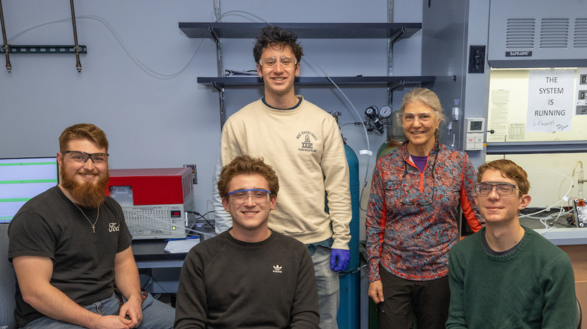
Thanks to Catherine Almquist, Ph.D., professor of Chemical, Paper, and Biomedical Engineering, new advances in compact, low-temperature air purification are happening at Miami University. Her project, funded through the U.S. Navy, strives to create a compact, photocatalytic device that will effectively and efficiently eliminate air contaminants where space and energy are premiums.
The grant funds $100,000 for the first year and is annually renewable for another two years. Almquist and her team of undergraduate and graduate students are charged to design, test, and construct a working prototype device that can decontaminate cabin air across the Navy’s underwater fleet. Six months in, their results are promising. “I’m very pleased,” Almquist said. “We have made good progress toward our research objectives.”
A photocatalyst is a material, such as titanium dioxide (TiO2), that speeds chemical reactions through light absorption – photocatalysis. First investigated in the early 1900s, photoreactive compounds gained renewed interest during the energy crisis of the 1970s when researchers found that photocatalysts can be used to generate hydrogen from water, a viable alternative to oil. However, photocatalysts’ ability to convert organic compounds into less harmful compounds at room temperature led to their widest application for air and water decontamination.
Almquist joined the Miami faculty in 2001 after earning advanced degrees in chemical and environmental engineering. Her Naval grant is a prime example of expertise meeting opportunity. She learned of the potential Navy funding while attending the annual conference of the American Institute of Chemical Engineers (AIChE). A colleague, aware of her focus on photocatalysts for air and water decontamination, handed her an index card he spotted on the conference’s message board which described the project’s specific and unique objective and contact info.
She promptly emailed the project’s instigator, a Navy civilian engineer specializing in environmental impact. A year later, he notified Almquist that the initiative received funding and that she had a mere 10 days to put together a proposal. Rising to the task, she submitted a detailed plan and ultimately won funding for the project that could total $300,000.
Unlike with many newly funded initiatives, Almquist enjoys the advantage of not starting from scratch. She’s leveraging applicable technologies she developed for the EPA in creating a UV LED-based photocatalytic device to eliminate evaporative fuel-vapor emissions. Thanks to the current Naval funding she could obtain more expensive materials such as platinum and palladium to synthesize photocatalysts.
“Having metals like platinum is a tremendous advantage in catalysis research,” Almquist said. “Platinum is an excellent, albeit expensive, catalyst and can be used to enhance the photocatalytic activity of titanium dioxide and other photocatalytic materials.”
Ultimate success entails developing a decontaminating device that saves energy by operating at room temperature versus 350oC+ of current submarine systems. Her team has already made several photocatalysts with platinum-doped TiO2 and will continue producing new iterations to find the optimal formula. Using small, robust UV-LEDs as a light source, their photocatalytic device, if successful, will effectively destroy air contaminants such as carbon monoxide, hydrogen, and volatile organic compounds.
Opportunities for undergraduate and graduate students
As much as the success and potential applications of their final prototype, Almquist is equally excited by the opportunity the project offers her students to learn by doing. “Because the grant is through the Naval Engineering Education Consortium, I have the chance to work alongside undergraduate and graduate students,” she said.
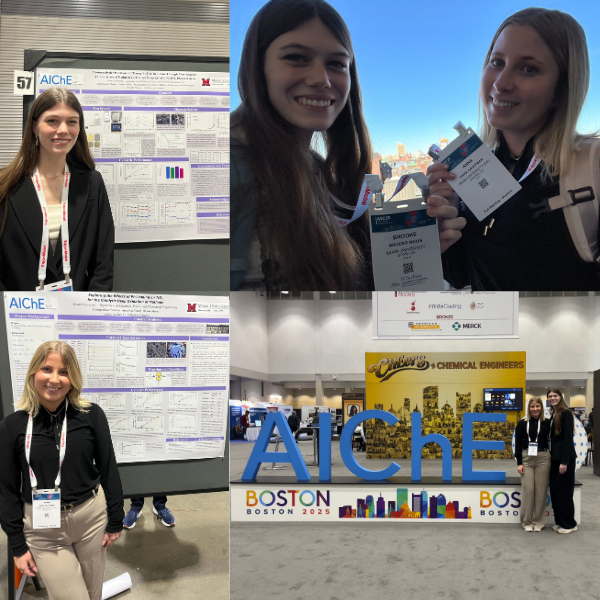
Beyond research and innovation, her student researchers are building invaluable soft skills, gaining teamwork and presentation experience. “Two students attended an AIChE student conference and participated in a poster competition where they shared their research with students from other universities,” she said. “It’s a powerful experience for undergraduates, and it gives them opportunities to network with graduate-school and company representatives and possible future employers.”
Her engagement for the Navy exemplifies the university’s commitment to affording transformative learning experiences. “Solving technical challenges is fun,” Almquist said. “When fully engaged and thinking critically, students can do great things.”