
Student teaching assistants awarded for contributions to CEC 111 and 112
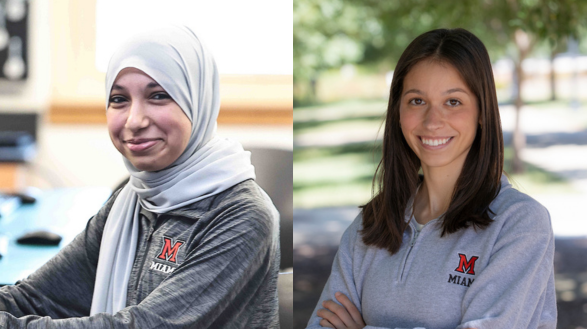
Hafsa El Harchi and Grace Holmes were awarded TAs of the Year
Student teaching assistants awarded for contributions to CEC 111 and 112
Hafsa El Harchi and Grace Holmes were awarded TAs of the Year
Hafsa El Harchi and Grace Holmes were recently named Teaching Assistants of the Year for their exceptional leadership and contribution to the success of CEC 111 and 112.
CEC 111 and 112 are required classes for first-year College of Engineering and Computing students. In a way that sets Miami apart from other institutions, these classes expose them to the different fields of engineering and through the implementation of hands-on projects and activities, students gain skills in communication, softwares, and team building, all while attaining community with their peers.
Both El Harchi and Holmes graduated this month with Bachelor of Science degrees in Biomedical Engineering. During her time at Miami, Holmes was a member of the Society of Women Engineers and was recognized for her contributions during her internship at the Nakamura Lab at Cleveland Clinic. El Harchi worked as a student assistant for the College of Engineering and Computing's Department of Chemical, Paper, and Biomedical Engineering and participated in outreach projects for Miami.
Between these academic endeavors, El Harchi and Holmes worked as TAs providing exceptional aid in CEC 111 and 112 according to the direction of their professors, often grading assignments, offering help to students during classes, and hosting office hours.
In this role, they have seen the impact the classes have left on students. El Harchi especially noted the community the class builds.
“Having that one class that’s dedicated to first-year engineers really allows you to connect with people you wouldn’t have met otherwise,” she said.
Within the class, students are assigned a group on the first day, which allows them to get to know people in their department and helps them grow in their social skills during a time in their lives when they are continually meeting new people.
El Harchi also mentioned the benefit of the class for the students’ educational experience.
“It's the first time where [they] actually understand what each type of engineering actually entails,” El Harchi said.
Holmes had something similar to say.
“I like how [the class] covers many concepts and areas of engineering, so everyone gets to explore before they really have to decide what they want to do,” she said.
As students themselves, El Harchi and Holmes were able to give first-year students special insights about the college, ranging from scheduling to general advice. This provided students with encouragement as well as guidance.
“Having someone who’s able to honestly be like, ‘Hey, you’re gonna get through this, but here's how to get through it easier’ goes a long way,” El Harchi said. “I really enjoy being able to help students in that sense.”
“I also have the pleasure of sharing all my study tips I’ve learned over the years and all my other random knowledge,” Holmes said.
Being a TA aided El Harchi and Holmes in their growth just as much as they were able to help their students grow. Interacting with the students gave them invaluable skills that they carry with them and will utilize in future workplace environments. Learning how best to communicate with the students provided them the opportunity to grow their mentorship and leadership skills while learning how to adjust their routes of communication depending on the audience.
“I think [being a TA has] definitely taken away a lot of the anxiety behind approaching new people and putting myself in awkward positions,” El Harchi said. “I’ve learned to trust the process of it’s all going to start uncomfortable somehow, but the end goal should always be in mind.”
Interacting with the professors also gave them the opportunity to gain mentorship of their own.
“I’ve gotten to know Dr. Ehlert really well,” El Harchi said, “and I think being able to have that informal relationship with a professor really helps, especially as I’m starting to think of post-grad and navigating this adult life. So, it’s been really nice getting to talk to her and learn about her experiences.”
In their roles as TAs, El Harchi and Holmes were not only able to provide remarkable aid for professors, but also give support to students while gaining professional skills of their own.