
Leading with Intelligence
Balancing Human Insight and Artificial Intelligence in Business Education
Leading with Intelligence
Balancing Human Insight and Artificial Intelligence in Business Education
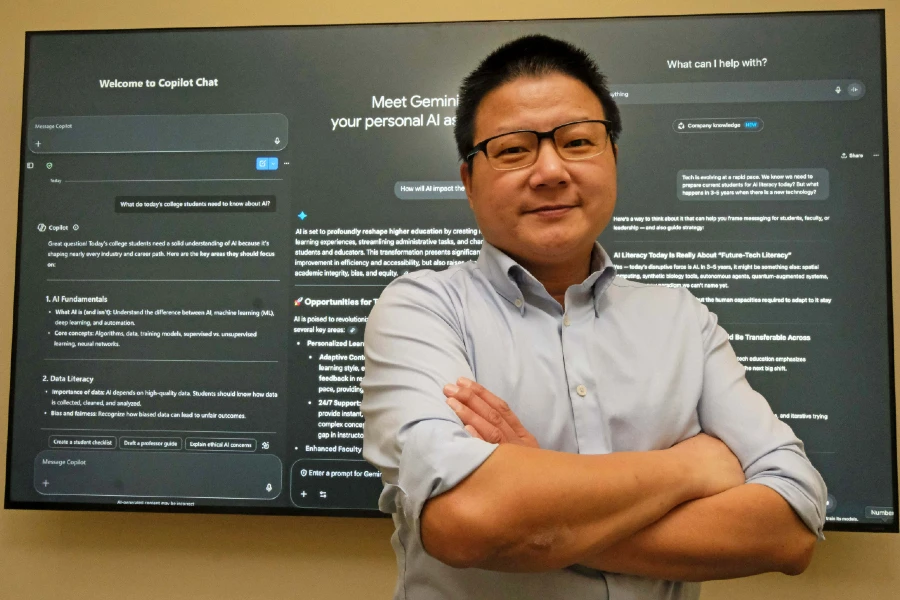
Artificial intelligence has entered classrooms, offices, and conversations across the world. Everyone from first-year students to CEOs is asking what it means for the future of learning and work. Some fear that AI makes it too easy to take shortcuts. Others see it as a powerful tool for elevating creativity and innovation to a brand-new level. At the Farmer School of Business (FSB), we see both the promise and the challenge, and we choose to lead with purpose.
At its best, AI does not replace human thinking. It enriches it. As Farmer School dean Jenny Darroch has described through her concept of “flipped thinking,” success in the age of AI depends on when and how we engage students in critical and creative work. By rethinking what we ask students to do before, during, and after using AI, we ensure they gain rather than lose the ability to think deeply and originally.
A Moment of Transformation
FSB’s AI story began long before ChatGPT became a household name. Years ago, a small group of Information Systems and Analytics faculty started exploring intelligent systems and data-driven teaching tools. Led by now retired Professor T. M. Rajkumar and joined by Allison Jones-Farmer, Fadel Megahed, and myself, this early group created a foundation of exploration and experimentation that now shapes the school’s strategic vision.
In Spring 2025, Jenny Darroch launched the FSB AI Initiatives and appointed me as the first Director of AI Initiatives, responsible for embedding AI into the educational experience, developing faculty training, and fostering AI-focused research and industry partnerships. She also appointed the first Director of Technology Innovation and Partnership to strengthen external engagement and build FSB’s reputation as a leader in how technology transforms business. The goal was not simply to add another technical program but to reimagine how business education should evolve in an AI-powered world.
. The Farmer School will stand at the frontier of AI education for business, leading the way in weaving AI into every dimension of our teaching, research, and operations.
“AI presents both an opportunity and a responsibility,” Darroch said. “Our students must be prepared not only to use these tools effectively but to understand their impact on business and society.”
Empowering Our Community
At the heart of our strategy is a simple idea: AI should empower people. Our vision is to enable every student, faculty member, and partner to use AI for innovation, insight, and impact. That vision comes to life through six focus areas: curriculum innovation, faculty empowerment, student engagement, AI-driven research, organizational transformation, and industry partnerships. But the essence is more human than structural. It is about preparing our community to lead with intelligence and integrity.
In classrooms, faculty are experimenting with AI-supported grading tools, case design, and interactive tutors that help students master coding or financial analysis. Professor Fadel Megahed’s ISA chatbot now coaches students on projects and interview preparation. In accounting, Professor James Zhang guides students through AI-generated scenarios that show how automation is reshaping auditing. In marketing, Lisa Kuhn and her colleagues have led specialized AI workshops exploring how generative tools can enhance content creation, consumer insights, and campaign strategy, giving students practical exposure to AI-driven marketing innovation. These are not futuristic experiments: they are happening now.
What unites these examples is not the technology itself but the intent behind it: using AI to create more time for meaningful human connection and higher-level thinking. This reflects the flipped thinking approach, which shifts attention from the final product of learning to the process of analysis, reflection, and improvement. Students develop stronger critical and creative capabilities as they engage thoughtfully with AI. Faculty members note that these tools let them focus less on logistics and more on mentoring and discussion.
Learning to Think, Not Just Prompt
Students today will graduate into a world where AI is everywhere. But knowing how to prompt a chatbot is not the same as knowing how to think critically about its answers. That is where the new AI for Business minor plays a key role. The program helps students understand technology, question its biases, and apply it ethically.
Courses such as Generative AI in Business and Big Data for AI Applications build technical fluency, while classes in strategy and ethics help students decide when and how to use AI in decision making.
Faculty across disciplines are exploring how to integrate AI into teaching and assessment. In courses across FSB, instructors are helping students learn how to work both with and without AI. Classroom activities include practicing how to craft better prompts, using AI for guided exploration instead of shortcuts, and engaging in AI-restricted exercises that strengthen independent problem solving. Many faculty encourage students to use AI extensively in team projects, from brainstorming and research to design and presentation, followed by deep reflections on how human insight complements machine intelligence. This approach emphasizes that only by learning to work without AI can students stay the captains of their learning journeys, with AI as the co-pilot. Working with AI then helps them collaborate effectively with their digital co-pilot, improving efficiency, creativity, and understanding in modern workplaces.
Through the AI initiatives, we are connecting AI champions across all units in our division to share best practices, support their endeavors, and strengthen collaboration across disciplines. . The discussions are candid: How do we measure learning in an age of automation? What does originality mean when ideas can be machine-generated? The answers are complex, but the conversation is shaping a new academic integrity built on transparency and trust.
Collaboration Beyond Campus
The future of business education does not stop at the classroom door. Leading companies are actively sharing their AI best practices with academia, and we are learning from them while adapting those lessons to fit our educational mission. Partnering with organizations such as EY, Databricks, and 84.51° helps students tackle real business challenges, from retail analytics to responsible AI design. These collaborations bring industry insights into the curriculum, help faculty stay current with evolving technologies, and give students confidence to apply their skills in practice.
Through collaboration between the Directors of AI Initiatives and Technology Innovation and Partnerships, FSB aligns curriculum innovation with real-world technological engagement. In the spring, the Farmer School will host its first AI Case Competition in partnership with Nationwide, inviting students to propose creative AI solutions to genuine business problems. The competition focuses on problem solving, creativity, teamwork, and ethical reasoning rather than coding expertise. These are the qualities today’s employers value most.
A Culture of Responsible Innovation
At the Farmer School of Business, we have made that mission personal. We call it a human-centered AI culture, one that values curiosity over compliance, collaboration over competition, and wisdom over speed.
In practice, this means preparing students for tools that do not yet exist, encouraging lifelong learning, and ensuring every experiment with AI includes an ethical lens. It also builds on Farmer’s commitment to developing KickGlass Skills: emotional intelligence, adaptability, ethical judgment, and collaboration. These skills help graduates thrive in workplaces that blend human and technological strengths.
The Road Ahead
The coming years will bring new programs, new partnerships, and new possibilities. In Spring 2026, several initiatives will mark the next phase of FSB’s AI strategy: the launch of an AI undergraduate certificate and a graduate certificate complementing the AI for Business minor, new AI Badges for both students and faculty, and the opening of an AI Innovation Lab where student teams and faculty collaborate on practical solutions.
At the same time, FSB is working with the MiamiTHRIVE committee to establish an AI Governance Committee to guide ethical use and responsible implementation of AI across all programs. Success will not be measured by course counts or funding but by the confidence and creativity of our graduates.
Our students understand that AI is not replacing what we learn; it is transforming why we learn. . The future of business will belong to those who can balance human judgment with machine intelligence. At the Farmer School of Business, that future is already taking shape.