Kelly Knollman-Porter
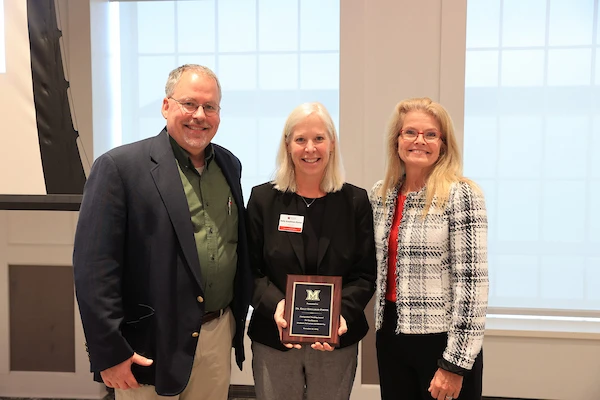

The Distinguished Teaching Award for Excellence in Graduate Instruction and Mentoring is given to faculty who demonstrate outstanding impact on graduate students and graduate education.
In 2025, 16 generous donations resulted in $990 being raised, which met 24% of an initial $4000 goal.
This $1,000 scholarship is awarded to a full-time graduate student based primarily on merit and secondarily on financial need. One student was selected to receive the Marjorie Post Farrington Award in 2025.
This award recognizes a significant achievement in a research or creative activity. Achievements in 2025 included peer-reviewed publications, externally funded grants, and earning fellowships. In 2025, 7 students from 6 different programs earned a Graduate Student Achievement (GSA) Award.
The International Grant-in-Aid (IGIA) award is intended to attract diverse international students to Miami's graduate programs, through a 100% tuition waiver. Thirty students received the IGIA in 2025.
The Grant-in-Aid (GIA) award provides a 100% tuition waiver to high-performing students demonstrating financial need. In 2025, 33 graduate students received tuition waivers for 40 funded semesters.
The Graduate School Scholar Assistantship (GSSA) is an assistantship used to attract and matriculate highly capable graduate student researchers. Eight students received the GSSA in 2025.
This award funds expenses associated with a student’s research for the master’s thesis or the doctoral dissertation. The Graduate School funded $4,115 in requests to 10 students in April 2025, and another $6,152 in requests to 14 students in November 2025.
This graduate fellowship through the Myaamia Center is designed for scholars motivated to make positive change in tribal communities and to share their research or interests on Miami University’s campus.
The purpose of the Graduate Summer Research Fellowship is to provide financial support for full-time graduate students to engage in meaningful scholarly activities during a 6-week summer period. The summer research fellowship is intended for students who have no additional means of summer support during the six-week summer period (e.g., grant-funded assistantship; external, paid internships; teaching assignments, etc.). Over 200 students received a Graduate Summer Research Fellowship in 2025.
Students conducted a variety of research endeavours, including: completing IRB applications, participating in internships, visiting archives, traveling to data collection sites, presenting at national conferences, conducting experiments, and submitting publications and presentations. For many students, the financial support they received was instrumental to their being able to fully immerse themselves in their research.
During the 6-week grant period, I spent time rewriting and revising my Master’s thesis, Beyond the Boundary: A Study of Academic Writing and Boundary Objects, with the goal of submitting the paper to an academic journal. At the start of the work period, I had a 53-page, 15,000+ word document that needed to be cut for length and revised for clarity of concepts. I needed to eliminate one chapter, both the introduction and conclusion, and half of another chapter in order to meet the length requirements for an academic article. Given the nature of my topic, I was unable to just cut and paste sections to fit a submission, as entire portions needed to be rewritten and updated for cohesive source usage. The first week of the grant period, I worked to revise and finish submitting two book reviews for publication, both of which have since gone live on their respective websites (“Walking Toward Meaning: A Review of Melissa Kagen’s Wandering Games” on constellations and “Review of Difficult Empathy and Rhetorical Encounters” in Peitho). Finishing these revisions and getting them published was unexpected, but helped to establish my credibility as a worthy scholar for publishing. I spent the next two weeks of the revision process working on the latter half of the essay, adding five new scholars to my analysis, connecting their scholarship to my previous work, and rounding out the theme of the essay. The next two weeks were spent on the front half of the essay, the arguably tougher portion where I first lay out my argument and the system of analysis. This section needed to be entirely rewritten, as it was initially designed to be half a reflection on my time as a Masters student and half on the presentation of theory.
My work process was interrupted for several weeks due to a death in the family. Once I returned and finished the revisions, I sent out my work to a few colleagues to be read for clarity and did some work with the Howe Writing Center to meet genre conventions. During this final week, I worked tirelessly with the revisions and citations to match them to my intended publication. I concluded the grant period by sending the article out to my first choice of publisher, Pedagogy, where I await hearing if my work will be selected for publication.
During my graduate summer fellowship, I was able to work towards spreading my research with others in my field. My paper titled "Elucidating the Drug Delivery Mechanism in Porous Antibody Implants Using Molecular Simulations and Graph Theory" was successfully published in the ACS Journal of Physical Chemistry B after its first round of feedback and revisions from the reviewers. Additionally, I started another research project early in the summer on combining molecular dynamics simulations of finite-sized self-assembled particles with a machine learning model and this paper is nearly ready to be submitted for peer review, where I will again be the first author. Aside from publications, I have been making significant progress on my thesis and will be ready to defend it in the next few weeks before beginning my Ph.D. research.
During the summer fellowship period, I worked on multiple research projects and my dissertation proposal. During this period, I published two research articles, one in the BMC Public Health journal and another in the JCO Global Oncology journal. Moreover, I worked on two manuscripts, and both are under peer review at Q1 journals. Likewise, I continue to work on my PhD dissertation proposal, and it is coming into shape.
During my Graduate Summer Fellowship, I made significant progress on my ongoing research project while also completing several side projects. Specifically, I co-authored two manuscripts submitted to peer-reviewed journals (Macromolecules and JACS) and submitted a first-author review article, all of which are currently under review. Additionally, I presented my work at the prestigious Gordon Research Conference (June 22–27, 2025) and Gordon Research Seminar (June 21–22, 2025) in Holderness, New Hampshire. I also attended the BioPacific MIP 2025 Summer School and earned certification in Automate the Bench: Getting Started with High-Throughput Synthesis (July 14–18, 2025) at UCSB.
During my summer fellowship, I was able to make significant progress on my dissertation. I was able to draft my first two chapters, which was an extremely important step in my degree and research progress. I was also able to set up all the necessary procedures to begin my data collection in the fall, which will truly help streamline the research process and data collection for my dissertation. In addition to my dissertation, I made progress on two outside research opportunities. Myself and three other Miami colleagues were able to make significant progress on an article we plan to publish in the journal "WPA" thanks to the fellowship. I was able to spend a significant portion of my time drafting and revising both with my co-authors and by myself. I was also able to make final edits on an article that will be published in September in the journal "WLN: A Journal of Writing Center Scholarship". Outside of this, I was also able to do some additional reading which was very helpful to the drafting of my dissertation chapters.
I was able to complete several research tasks during my Graduate Summer Fellowship. My time was devoted to completing a publication and progressing on my milestones, as well as continued recruitment and completing lab visits for ongoing projects in my research lab on campus. I completed a manuscript for publication working in collaboration with my mentor which was accepted to the Journal of Family Psychology this summer. In addition, I was able to begin working on my Comprehensive Exam milestone brainstorming ideas and forming a research question with my mentor.
My progress this summer has prepared me well to continue work on this milestone throughout the academic year. Finally, several of my tasks during my Graduate Summer Fellowship consisted of working on ongoing research projects in my lab. I assisted with recruitment tasks, led research visits, and prepared training materials for undergraduates for the academic year. Overall, I was able to progress nicely on several research projects and prepare myself for success for the upcoming academic year.
During my Graduate Summer Fellowship, I conducted an empirical research study titled Untangling the Association between Financial Strain, Sleep Disorder, High Blood Pressure, and Subjective Cognitive Decline among Older Americans. The goal of this project was to investigate how ongoing financial strain, alongside other health-related factors, contributes to subjective cognitive decline (SCD), a self-reported measure of worsening memory that has been recognized as a critical early marker for dementia risk. Using data from the RAND Health and Retirement Study (RAND HRS), spanning 1992 to 2020 (waves 10–15), I constructed an analytical sample of 34,261 older adults (13,753 males and 20,508 females). SCD was operationalized as subjective reports of worsening memory, and a generalized mixed model with a binary logistic link was employed to test associations with key predictors, including financial strain, sleep difficulties, depression, and self-reported health.The analyses revealed that financial strain was strongly associated with subjective cognitive decline. Specifically, older adults who reported that financial problems were “very upsetting” had 48.4% higher odds of reporting SCD (OR = 1.484, 95% CI: 1.242–1.772, p < .0001). Sleep difficulties also significantly increased the likelihood of SCD (OR = 1.426, 95% CI: 1.298–1.566, p < .0001), as did depression (OR = 1.650, 95% CI: 1.448–1.880, p < .0001). The strongest association was observed between SCD and self-reported poor health, with older adults in poor health having nearly six times greater odds of reporting cognitive decline (OR = 5.791, 95% CI: 4.810–6.971). These findings extend the literature on early detection of dementia by highlighting the interplay between financial stressors and health-related risk factors.
Through this fellowship project, I not only deepened my skills in statistical modeling and longitudinal data analysis but also produced a research product with clear implications for public health and gerontological practice. The study underscores the importance of integrating financial literacy and economic well-being into cognitive health interventions, as well as addressing sleep quality and emotional health as part of holistic dementia-prevention strategies. The results from this fellowship project are being prepared for dissemination at professional conferences and as a manuscript submission to a peer-reviewed journal.
Overall, the fellowship provided me with the time, mentorship, and resources necessary to generate impactful findings that can inform both scholarship and practice in aging and cognitive health.
The purpose of the NSF Graduate Research Fellowship Program (GRFP) is to ensure the quality, vitality, and diversity of the scientific and engineering workforce of the United States. GRFP seeks to broaden participation in science and engineering of underrepresented groups, including women, minorities, persons with disabilities, and Veterans.
In addition, the Graduate School is committed to preparing our students for applying for the NSF GRFP. In August-October 2024, we offered a GRFP Application Support program to mentor students in preparing and submitting successful applications.
Miami was honored to have four active recipients of a GRFP in 2024.