Skip to Main Content

The Three Minute Thesis (3MT®)

Ten finalists competed in the Miami University Graduate School Three Minute Thesis (3MT) competition held Oct. 18. Finalists were selected from among graduate students who participated earlier this month in the research communication competition. The 3MT, held at more than 900 universities worldwide, challenges participants to present their research in just 180 seconds in an engaging format that can be understood by an intelligent audience with no background in the research area.

Onisha Thapa, Anastasiia Evstifeeva, and Dustyn Weber
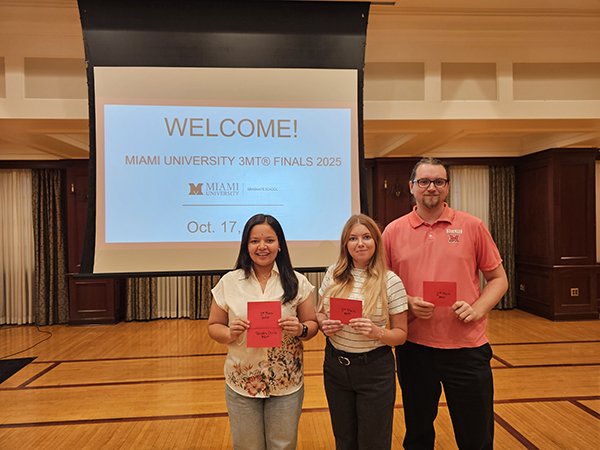

three minute thesis winners

Winners

First place ($1,200 prize): Onisha Thapa, second-year doctoral student in Chemistry, with advisor Gary Lorigan, University Distinguished Professor of Chemistry and Biochemistry, for her presentation “Study of Structural Dynamics and Topology of the TatE Peptide in a Lipid Bilayer.” Thapa, an international student from Nepal, conducts research on membrane proteins and their structural topology, using various biophysical techniques to understand protein-membrane interactions and conformational dynamics. She will compete in the Midwestern Association of Graduate Schools (MAGS) Three Minute Thesis competition in Kansas City, March 2026. Thapa also won the People's Choice award ($500 prize). 

Second place ($950 prize): Dustyn Weber, MS ’23; second-year doctoral student in Chemistry, with advisor: Cory Rusinek, assistant professor of Chemistry and Biochemistry, for Detection and Quantification of Manganese in Pretreated Samples by Electrochemistry.

Third place ($600 prize):  Anastasiia Evstifeeva, fifth-year doctoral student in Chemistry, with advisor Rick Page, associate vice president for research and innovation and professor of Chemistry and Biochemistry, for her presentation “Understanding How NDM Enzymes Defeat Antibiotics.”
Graduate Research Forum

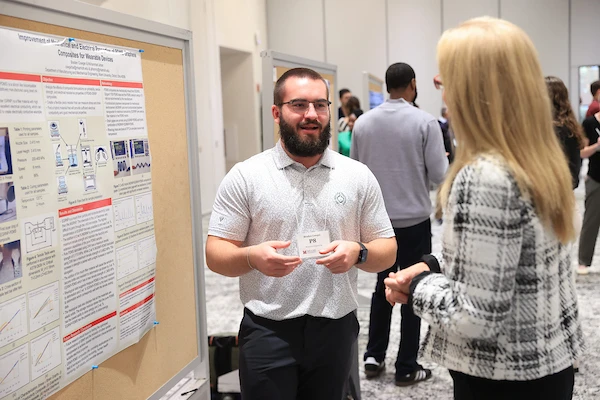
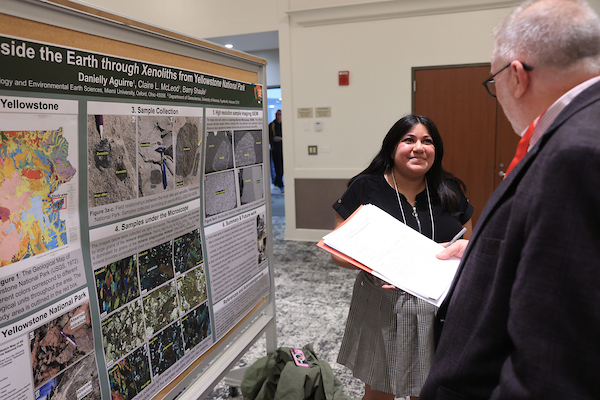
The Graduate Research Forum (GRF) provides an opportunity for Miami graduate students from all departments to share their scholarly work with the university community. The 17th annual GRF took place on Nov. 7, 2025. Over 90 graduate students participated in in-person poster presentations, oral presentations, and art presentations. Presentations were evaluated by alumni and faculty judges, and top presenters received awards of professional expense funds.
Mike Crowder talking with poster presenter

Top Oral Presentations: Non-STEM

  • Alexia Inman
    • Title: The Impact of Trauma and Mental Health Literacy on Mental Well-Being in Division I Collegiate Athletes
    • Program: Sport Leadership and Management, Master of Science
    • Advisor: Christine Pacewicz
  • Jenna Lickovitch
    • Title: The influence of body-related self-conscious emotions on female young adults' physical activity and eating behaviors
    • Program: Sport Leadership and Management, Master of Science
    • Advisor: Christine Pacewicz

Top Oral Presentations: STEM

  • Taylor Barber
    • Title: Adjuvant-Based Therapy Abolishes Antibiotic Resistance Conferred by Methyltransferases
    • Program: Chemistry, Doctor of Philosophy
    • Advisor: John Alumasa
  • Alexandra Bros 
    • Title: Daily Phytoplankton Dynamics During a Wet Spring-Summer and Subsequent Late-Summer Drought in a Hypereutrophic Reservoir
    • Program: Biology, Master of Science
    • Advisor: Lesley Knoll

Top Poster-Presentations: Non-Stem

  • De-Graft Boateng
    • Title: Fragments of Progress: Exploring the Human and Environmental Cost of Global Consumerism and Resource Extraction
    • Program: Art, Studio, Master of Fine Arts
    • Advisor: Geoff Riggle
  • Michaela Levendoski 
    • Title: Tackling the Opioid Crisis: Addressing Substance Abuse in Rural Communities
    • Program: Physician Associate Studies, Master of Medical Science
    • Advisor: Chris Grimm

Top Poster-Presentations: STEM

  • Emily Medema
    • Title: The Moon’s Return: A Geologic Investigation of Dominion Range (DOM) Lunar Meteorite 18262
    • Program: Geology, Master of Science
    • Advisor: Claire McLeod
  • Keiana Mazzio
    • Title: Investigating Human Induced Seismicity in the Eagle Ford Shale Play: Evidence for Hydraulic Fracturing Correlating with Increasing Magnitudes of Seismicity
    • Program: Geology, Master of Science
    •  Advisor: Michael Brudzinski