
Miami University alumni working for NASA excited about Artemis II lunar mission
One Miamian is involved in the mission, another is researching a new class of solar cells that can be manufactured in space and on the moon
Miami University alumni working for NASA excited about Artemis II lunar mission
One Miamian is involved in the mission, another is researching a new class of solar cells that can be manufactured in space and on the moon
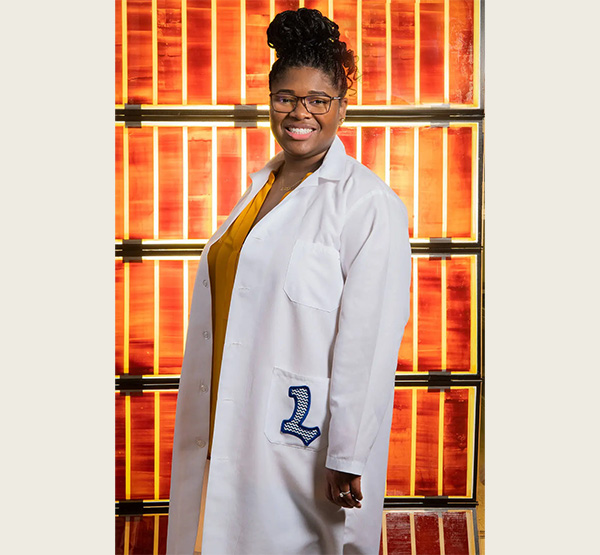
As NASA prepares for today's Artemis II lunar flyby launch, several Miami University alumni with connections to NASA are looking forward to the 10-day mission.
Four astronauts — the first crew to leave Earth’s orbit since 1972 — will travel around the moon and back. The Artemis II test flight is the first crewed mission under NASA’s Artemis Program.
“This mission will send astronauts farther from Earth than any human has ever been, and it’ll be the first to take humans to deep space in more than 50 years since the Apollo Program,” said Lyndsey McMillon-Brown ’13. The research electrical engineer at NASA Glenn Research Center in Cleveland focuses on solar cell materials development.
Expected to launch from Kennedy Space Center in Florida at 6:24 p.m. today, the Artemis II mission is “a critical stepping stone toward our grand goals for space travel,” she said. “In addition to giving us additional information about the moon through lunar science objectives, this flyby will give us vital information about how our systems and hardware perform. I am deeply excited to witness this historic launch.”
Leading a team of researchers
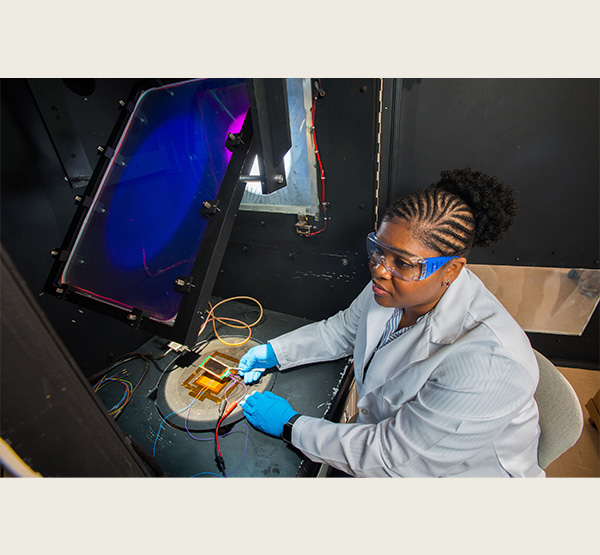
McMillon-Brown — one of several Miamians with connections to NASA — is leading a team of researchers to develop a new class of solar cells that can be manufactured in space and on the moon.
“As we think about what we will need to support a sustained human presence on the moon, and eventually on Mars, we quickly realize we need a lot of stuff,” she said. “You're going to need a lot of power (electricity) to run all of the life support systems, engineering equipment, and additional equipment that supports scientific exploration.
“To achieve the mission goals and deliver reliable power, NASA will implement various technologies in concert, similar to how there are many different technologies contributing electricity to the electrical grid here on Earth,” she said, adding that they envision contributions from nuclear power, batteries, solar cells, fuel cells, and potentially other sources, too.
The perovskite-based solar cells she is working on are special in that they can be easily manufactured in space, she explained. “This could help to forgo launching massive and space consuming solar arrays and instead launch precursor materials and build what we need once we land. This technology has potential to add reliable and versatile energy sources to our future moon base.”
McMillon-Brown earned her bachelor’s degree in Mechanical and Manufacturing Engineering from Miami’s College of Engineering and Computing (CEC). She earned a master’s and doctorate in Chemical Engineering from Yale University. She spoke at CEC’s 2025 commencement ceremony.
“Miami gave me a tremendously strong technical foundation so that I can critically think and solve complex engineering problems in real time,” she said. “Miami also helped me to hone the so-called 'soft skills' like communication, leadership, and determination to persevere in difficult times — which I feel are just as critical in my career.”
Jeff Triplett ’06
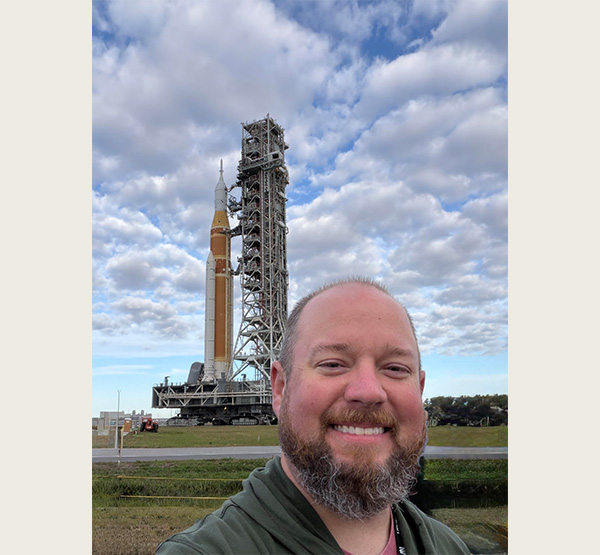
Since 2022, Jeff Triplett has served as senior Linux Lab manager at NASA, where he is the lead for the Flight Science Lab (FSL) at Johnson Space Center in Houston. The role has him directly involved in the 10-day mission.
“All the engineering analysis before, during, and after the mission use the FSL High Performance Compute (HPC) Services. In fact, the FSL is used for most engineering analysis for all crewed flights, including Commercial Crew, Human Landing System (HLS), and Artemis,” he said.
Previously, Triplett was HPC (High Performance Computing) operations manager for the Ohio Supercomputer Center from 2020 to 2022.
Triplett, who earned a Bachelor of Science in Applied Science in Computer Engineering, worked for Information Technology (IT) at Miami in various roles for more than 14 years, from 2006 until 2020. Those roles ranged from network support specialist and systems administrator to manager of enterprise systems and manager of enterprise database and systems operation.
Working at NASA 'was a dream'
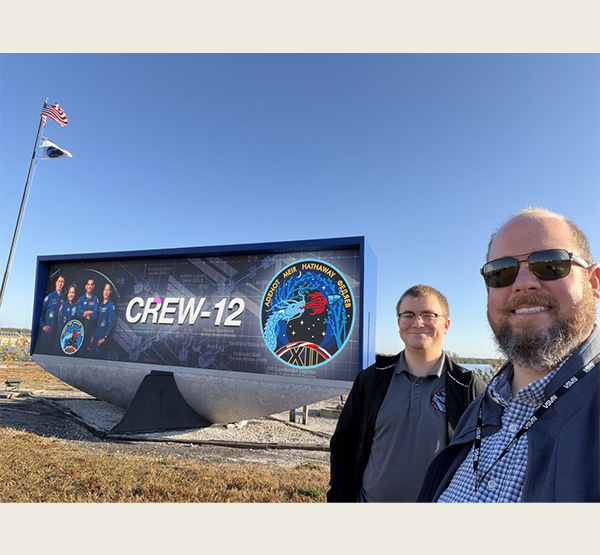
Triplett said he has always loved NASA and anything with space travel.
“Working at NASA was a dream but not something I thought I would be able to achieve as I did not go to school for aeronautics or a similar degree. But making a career in Information Technology (IT) and specifically in High Performance Computing (HPC) opened an opportunity with NASA,” he said. “After starting at NASA, I have found there are many opportunities for working at NASA outside of the traditional aeronautics degrees.”
He called the NASA experience one of the most rewarding jobs he has had in his career.
“I have the privilege of working daily with some of the top engineers in their discipline. With this new time in space travel, it has never been a more exciting time to work at NASA,” he said.
Triplett will be back in Oxford to speak at the CEC Innovation Summit later this month.
Formerly known as the Alumni and Friends Conference, the CEC Innovation Summit brings together students, alumni, faculty, staff, friends, community members, and industry partners. Register for the event, which runs from 5-9:30 p.m. April 23, and 8 a.m.-5 p.m. April 24 at the Marcum Hotel and Conference Center. The RSVP deadline is April 14.
Sarah Waechter ’04
Sarah Waechter is deputy project manager of NASA’s Sustainable Flight Demonstrator Project. Waechter, who earned degrees in Engineering Management and Manufacturing Engineering from Miami, has emerged as a leader in sustainable aerospace innovation.
She participated in CEC’s 2024 Alumni and Friends gathering, hoping to inspire the next generation of engineers in Oxford. Reflecting on her decision to return to campus, she shared: “I wanted to give back. I was inspired by somebody that came and talked to our school.”
Sarah Freeman ’25
Sarah Freeman ’25, who earned bachelor’s degrees in Mechanical and Manufacturing Engineering from Miami, is now pursuing a doctorate in Aerospace Engineering from Texas A&M University. Freeman announced on LinkedIn that she will be returning as an intern this summer at NASA Marshall Space Flight Center in Huntsville, Alabama, to support the Human Landing Systems team.
“This will be my third NASA internship, and the sense of awe that comes with contributing to the agency’s mission never fades,” Freeman said in the LinkedIn post. “With new momentum building across NASA, I’m excited to play a small part in what’s ahead.”
Watch this video of Freeman and read the Q-and-A when she was a Miami student and an intern at the NASA Glenn Research Center in Cleveland.
Bradley Gartner ’25
Bradley Gartner announced he will be in the NASA Pathways Program at the Marshall Space Flight Center, where he interned previously.
“I look forward to returning to NASA for the upcoming spring term and taking one step closer to reach my long-term goals,” he said in a LinkedIn post.
Gartner, who graduated with a degree in Robotics Engineering and is now a graduate student in the Department of Electrical and Computer Engineering, said during a Q-and-A while he was an undergraduate student at Miami:
“After graduation, I plan on attending graduate school and hope to start a career at NASA with the hope of becoming an astronaut in the future.”
Established in 1809, Miami University is located in Oxford, Ohio, with regional campuses in Hamilton and Middletown, a learning center in West Chester, and a European study center in Luxembourg. Interested in learning more about the College of Engineering and Computing? Visit the website for more information.