
'AI doesn't reduce work, it intensifies it' Speaker shows faculty new ways to use artificial intelligence in the classroom
Former Miami University dean comes back to help faculty see ways to use AI rather than fear it
'AI doesn't reduce work, it intensifies it' Speaker shows faculty new ways to use artificial intelligence in the classroom
Former Miami University dean comes back to help faculty see ways to use AI rather than fear it
Depending on who you ask and in what context, artificial intelligence is often considered either a great threat, a great opportunity, or a mix of both. José Bowen would likely fall into that last category, but with an edge toward optimism.
“AI is changing work. That's clearly happening. In fact, for me, it's all about thinking about the new workflow and about what is it that I have to do, and what is it I don't have to do?” he said. “But AI is also changing human thinking. And man, that should concern you a lot, because it's what we do for a living, right? We teach them how to think. And so, if AI is changing that, what does that mean?”
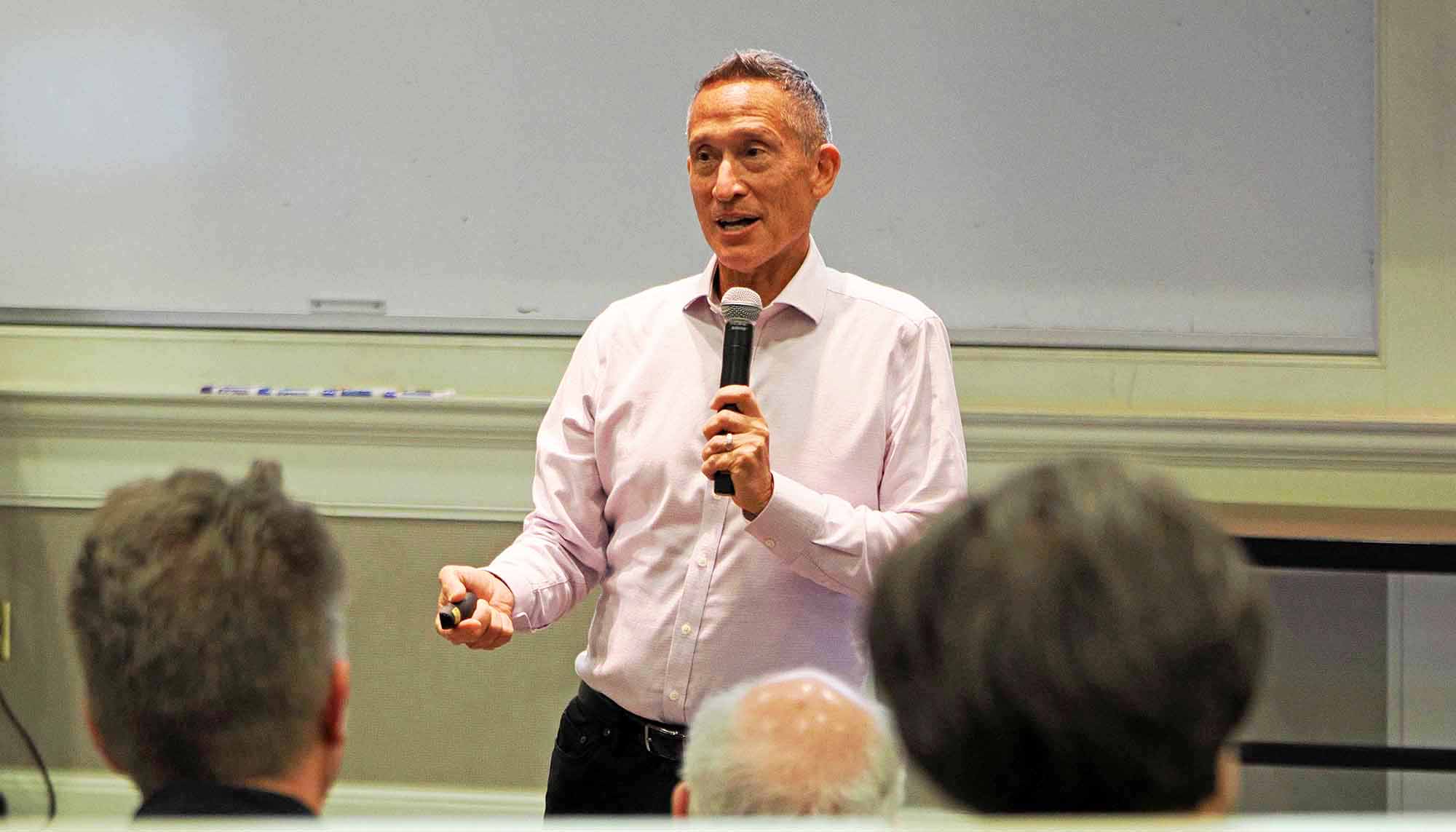
Bowen is an author, a former college president, and has worked in the arts for most of his career, including a stint as dean of Miami’s School of Fine Arts. The audience for his recent talk about AI at the Farmer School of Business was not students, but Miami University faculty members and graduate students.
He started his talk by looking at “cognitive technologies,” and how we selectively choose to use them. The challenge isn't the offloading the thought work itself, Bowen said, but deciding which cognitive muscles are okay to let atrophy and which ones are essential.
“When you make a list to go to the grocery store, you are cognitively offloading,” Bowen said. “If I show you a campus map for the first time and then take it away, can you still envision the campus? So even when I take the map away, you're still smarter in a way. But if I give you GPS and then take that away, you're just lost. So, you cognitively offload in a way that's permanently deskilling.”
Bowen explained that the labor market is currently being hit by a wave of "the new average." If an AI can produce "C-level" work instantly – a standard essay, a basic marketing plan, or generic code – then a human worker who only offers that same quality is effectively unemployable, he said. Entry-level jobs are under extreme pressure because the "starter tasks" are what AI does best.
“One of the leading interview questions at the moment is, ‘How do you use AI to make your work better and faster? How does your workflow change with AI?’ If your students can't answer that question, they're going to have a hard time,” Bowen said.
Bowen said it’s important to realize that AI isn’t just a tool, but a new form of labor that must be managed.
“When your students graduate, they will immediately need to be a manager. You can't wait for graduate school to learn management and delegation; those are now undergraduate skills. Everybody is going to be managing AI. You are now an AI boss for the rest of your life, and your students will be too. That's the new workplace,” he said. “AI offers possibilities to help and also to hinder learning, so we've got to be really attuned to that.”
Bowen said that what seem like basic skills are becoming more important because of how we interact with AI.
“Writing is still important. This is writing, clarity, specificity. It's a literal language model. Learning how to write for AI prompts is important, but being a good AI user is asking better questions and evaluating answers,” he noted. “It's critical thinking. You all teach AI literacy, even if there's no AI in your class, because the thing that employers most want is people who can ask new questions, think differently, read, and reorganize their workflow.”
Bowen said that faculty can take advantage of AI’s capabilities to make their teaching more effective.
“I can now customize every assignment for every student. I can have them fill out a Google form and tell me ‘What motivates you the most. What are you most excited about?’ And then I give AI my generic assignment, and I say, ‘Make an individual, customized assignment that's more motivating for each student,’” Bowen said. “I can also go through a process with them where I ask, ‘How does this assignment overlap with what you really want to do when you graduate?’ AI is really good at helping make those connections.”
“Customization has been a long-term pedagogical technique. We now have a way to do it at scale with AI,” he said.
Bowen said that AI doesn't mean we think less; it means we must think more deeply about what we are doing.
“One thing that I find is so totally true is that AI doesn't reduce work, it intensifies it. I can now do more things,” he said. “The biggest problem I have is deciding what I should have AI do before I go to bed overnight? I have 1,000 interns living in my computer. What do I want them to do that could be useful for me tomorrow?”
Related: Shan takes on new role as Director for AI Initiatives at FSB