
Panel examines role of artificial intelligence in human resourses now and in the future
Experts discuss the potential and the pitfalls of incorporating AI into human resource management
Panel examines role of artificial intelligence in human resourses now and in the future
Experts discuss the potential and the pitfalls of incorporating AI into human resource management
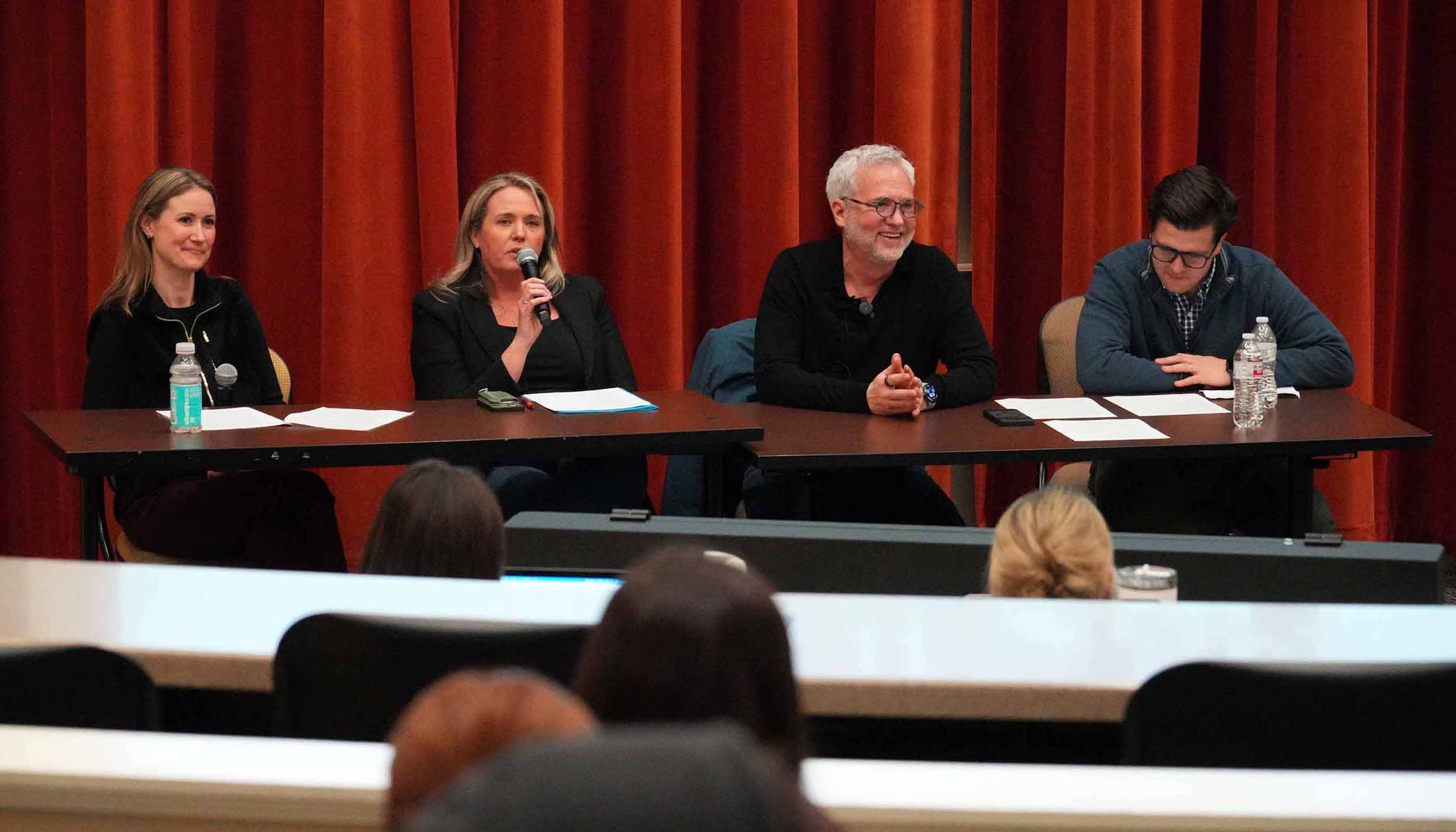
What roles can or should artificial intelligence have in the world of human resource management? That was the topic of discussion in Taylor Auditorium when assistant lecturer of Management Tom Mobley hosted a pair of HR executives and a pair of AI experts for a conversation.
“Someone who is willing to use AI, and do it ethically and responsibly, will replace somebody who is not using AI,” Lynsey Gaca, manager, human resources business partner at Ascendum Solutions, explained. “Roles do need to adapt and change, because the technology is changing, but how do we train people appropriately? How do we educate them on it? And then, how do we ensure that we're still protecting people's privacy and their data?”
“AI is really helping with any kind of task-oriented administrative work. So, if you think about ChatGPT, it can help you create a job description or being able to take data to look at performance reviews,” Lean Effective Talent Strategies founder Jodi Brandstetter said. “Where it's not working is where there have to be decisions, so a human needs to always be in the loop.”
“AI should be used to help you be better at what you do, but it really should not be making business decisions. It should help guide you and help you make the decision,” she said.
Glenn Platt wears a lot of hats at Miami University. He’s the Armstrong professor of emerging technology, director of the Armstrong Institute, a professor in the Emerging Technology in Business and Design department and the Department of Marketing. Platt is also the CEO and co-founder of a human resources AI tech company.
He said that he sees three areas of job disruption with AI:
- Jobs that are eliminated because AI can do them
- Jobs that are done more efficiently with the help of AI
- Jobs that didn’t previously exist for those who harness and work natively with AI
“I think absolutely some jobs are going away, but I do think that in net, this will also mean more jobs, but they're not jobs that are just going to fall in your lap in the way that they had previously. It's going to require you to develop a set of skills and abilities,” Platt said.
Brandstetter said that long before bringing AI in, an organization needs to have good data and documentation on the technology they’re already using.
“If they're lacking that, whatever they put together is not going to be sustainable. It's pretty much taking a failed system, and then they’re multiplying it by 10 by putting AI on top of it,” she said. “So, I think the first thing is really having organizations do a thorough work workflow from A to Z in HR, and then determine what is a human touch point, and what can AI actually do?”
“I think we're all assuming that companies know how to hire, and they have a process, but there are a lot of organizations out there that do not. So, if they try to put some sort of AI tool in it, it's going to fail. Maybe the first thing to do is have a hiring blueprint where it goes through all the different steps of what you want to accomplish in hiring, then you can start looking at AI to be a part of it,” Gaca said. “But the other piece is that candidates want to understand not just AI, but the actual process itself. So, there must be some transparency in the hiring process for the candidates.”
Platt said he thinks that human resources at a company will be seen as a cost center, and one that needs to keep its costs down.
“You need to position the HR organization as part of the revenue generating capacity of the company, and make sure what you do is help people perform better, be more happy at their jobs, be more effective at their jobs. You are integral to that. And I think AI provides some of the threads that allow you to do that,” he said. “Nobody likes performance reviews and management, but at the end of the day, we need to figure out how do we help people perform better? And I think if we come through it with that lens, there are AI tools that make that more sort of easier for us and more cost effective.”
The panelists offered some advice for companies and for students that are looking to the future of AI in human resources.
“Get really good at asking questions like a toddler. That should be your mindset, to keep asking questions, funneling those into chatbots, see what it comes up with, and keep guiding it,” Alec Vivian, senior data engineer at Revecore, said. “Just keep prompting, because what's going to really help is being able to determine what gets a good response, what gets a bad response from the AI.”
“Allow your employees to fail, give them the space to be curious enough to try something and it might fail, because if you don't let failure become part of your time, you're not going to be innovative. A lot of times, employees just feel like they can never fail, or they're going to be fired, or they're going to get a demotion,” Gaca said. “Opening it up and saying, ‘We want you to fail, we want you to be curious enough to try something new.’ Maybe you put some guardrails around it, but give them the ability to fail and you're going to be a more innovative organization.”