Eat last, serve others, be reliable: KKR partner shares leadership wisdom learned in business and politics
Former RNC chairman, business leader talks about ways to be a better leader

Eat last, serve others, be reliable: KKR partner shares leadership wisdom learned in business and politics
Former RNC chairman, business leader talks about ways to be a better leader
Let’s say you’ve just finished being the youngest chairman of the Republican National Committee, a job that you’ve had since you led George W. Bush’s successful presidential reelection campaign.
Now what do you do?
If you’re Ken Mehlman, you reach out to leaders at the private equity and investment firm KKR and build a relationship, because you have an idea.
“The thesis we had is that if you understand the world from a public policy, political and geopolitical perspective, you can use those insights to help inform better investments, avoid bad investments, and create value in companies. I've been doing that for the last 18 years,” Mehlman said.
As a Partner & Global Head of Public Affairs, Mehlman helps leverage public policy, geopolitics and sustainability to enhance the firm’s investing strategies and portfolio governance.
He said that COVID, Russia’s attack on Ukraine, and the Iran conflict have driven home the concept that the United States and its allies need to be less dependent on other nations for critical sectors, infrastructure, and resources.
“We are now investing heavily in a combination of domestic capacity and capacity in our allies around indispensable sectors like pharmaceuticals, semiconductors, shipbuilding, energy – sectors where we learned during COVID that just-in-time global supply chains are too risky. And in order to build these out, policymakers need trusted private capital,” Mehlman said. “All of those are opportunities for a firm like KKR or our portfolio companies to invest.”
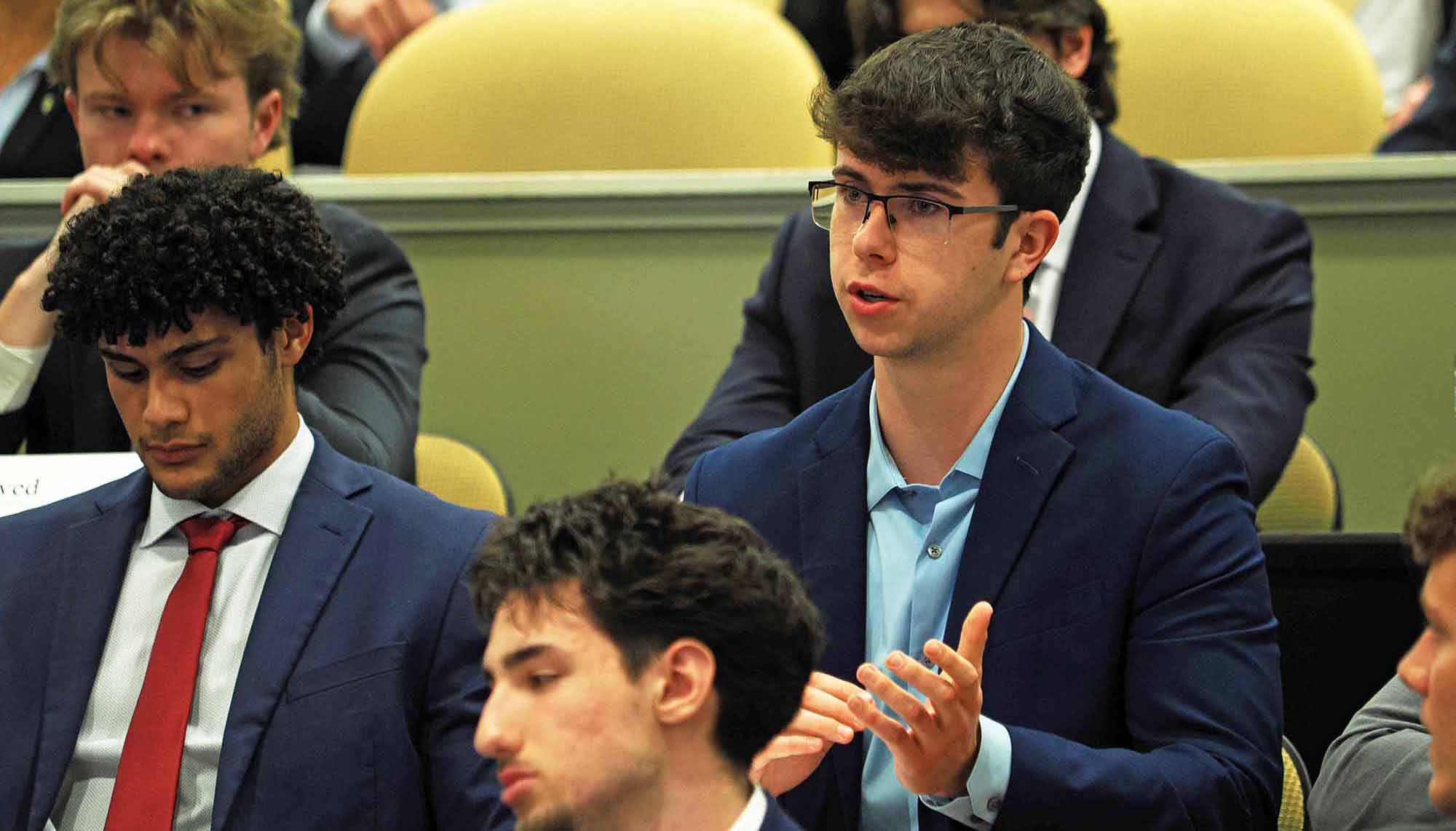
His talk to Farmer School students and members of the Miami University Banking Club focused not just on financials, but on lessons he’s learned about leadership and being your best self, starting with his years in politics.
Regarding his role in the Bush reelection campaign, Mehlman said, “I was essentially the founder and the CEO of a startup that in the course of a year and a half, would employ 2,000 people, mobilize 2.1 million volunteers, spend a billion dollars, and be at the top of the news cycle every day.”
Lesson 1: Leaders eat last.
“Great leaders are people who motivate others by putting them first,” Mehlman said. “I had a bunch of people that worked for me who were 20 years older than I am. The best way I could lead them is to help them,” he said. “I was their boss, but I had to earn the right to be their leader by enabling, empowering, and equipping them for success.”
He noted that during the Bush campaign, he worked to ensure that it was a meritocracy, that hard work would be rewarded with opportunities and promotion.
“They had to understand that I put them first,” he said.
Lesson 2: If you want to be a great leader, serve others.
“If you serve others all the time, and people know that about you, they're going to be much more likely to follow you,” Mehlman said. “If you help people, people are always going to respect you. Help people that no one else wants to help. Help people that you don't need anything from.”
Lesson 3: Be reliable.
“It’s more important than almost anything in the world for me to be reliable to people I work with, to my loved ones, to people that are in my life, friends, whatever. And if being reliable means there's something I want but is inconsistent with a commitment I’ve made or mission I signed up for, then my wants come second,” Mehlman said. “So, the reason to do or not do something shouldn’t be based what people will think of you. You do something because it’s consistent with who you are.”
“If you tell yourself early in your life, ‘This is who I am and who I'm going to be,’ and you live according to that code, that's very powerful,” he said.
Mehlman talked about the philanthropic effort he is starting called the Slingshot Project, which has a mission to empower, mobilize and learn from people who have overcome the most difficult of circumstances.
“People who have faced struggles and obstacles build assets in the context of dealing with them, and those assets can be applicable on other components of their lives. You can capitalize all these assets you built,” Mehlman said. “In today's world, there are going to be a lot more people that face struggles, that need to rebound and be resilient, and we can learn from those people as to what it takes and how to apply it.”
And while most of his speech talked about things students should do, he also noted some things they shouldn’t.
“Once you decide who you want to be in 5 or 10 years, the next question is, ‘What are you willing to sacrifice to focus on achieving this?’ Command focus is incredibly power, and to focus, you need to give up other distractions,” Mehlman said. “But never sacrifice time with your family and your loved ones. Never sacrifice that because that's limited. Never sacrifice ethics. Never sacrifice by cutting a corner to do something that's wrong. Never sacrifice treating someone in the right way. Never sacrifice those things.”