
FSB business analytics graduate students present work to Major League Baseball
Team's work with Cleveland Guardians earns them meeting with MLB
FSB business analytics graduate students present work to Major League Baseball
Team's work with Cleveland Guardians earns them meeting with MLB
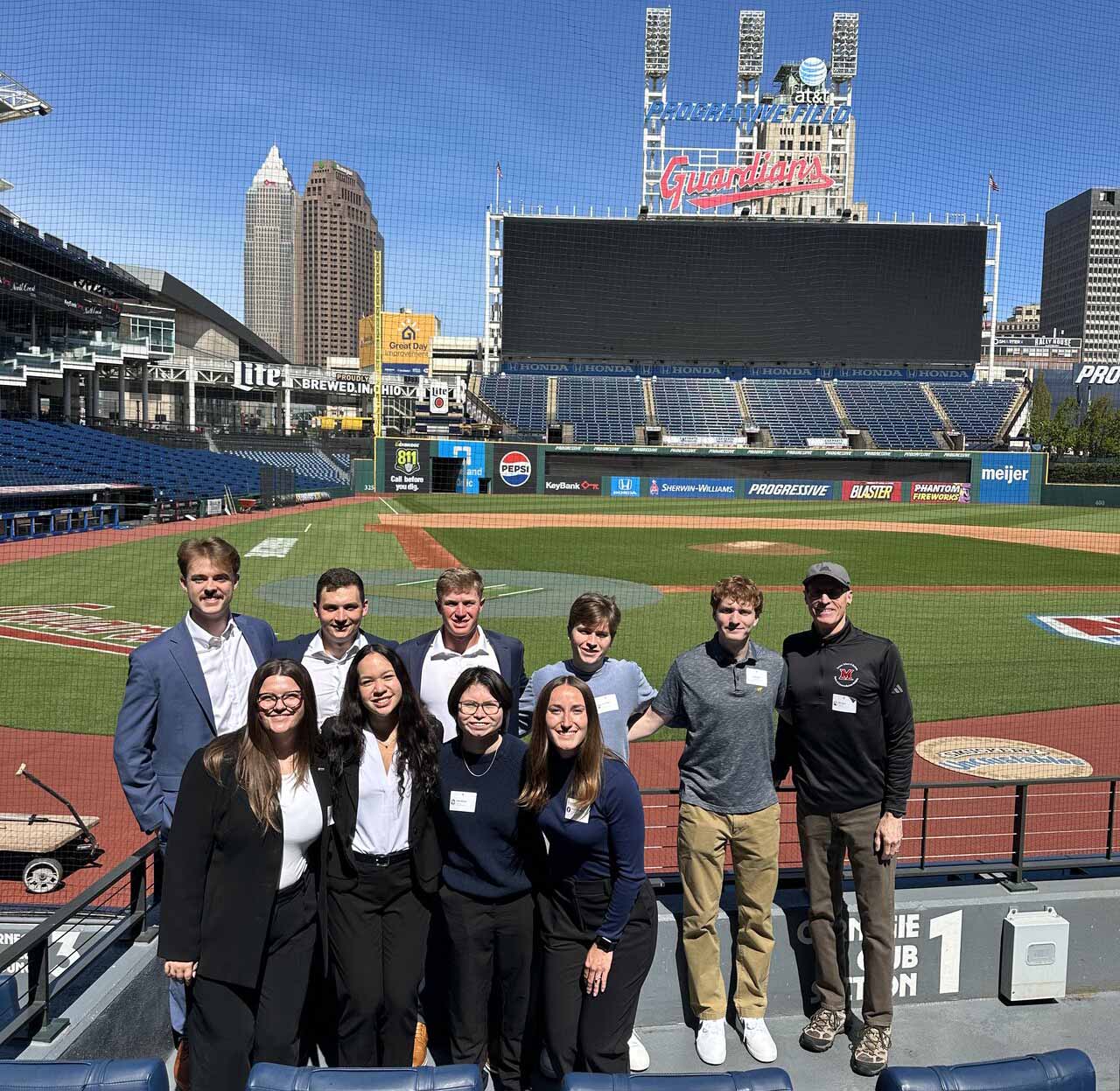
A team of Farmer School of Business Master of Business Analytics students not only impressed their client with their work this spring, but they were also asked to present their work again to a much bigger audience.
Heather Siudak, Ryan Altic, Kate Uhrick, and Jack Julian were part of this year’s MSBA cohort.
“I felt like I had a strong understanding of business analytics and anything in that realm, but I wanted to have a leg up going into the professional world,” Julian said.
“I saw the MSBA program, how it was only a year long, and how it would utilize a lot of my background in statistic, but also allow me to learn a lot about business, making everything into a business context,” Uhrick said.
Earning the MSBA requires taking part in the program’s six-credit client practicum course. In this course students work with companies on real analytics problems for an entire semester and present to their clients at the end. This year students worked with Nationwide, U.S. Bank, Cincinnati Bengals, Cleveland Guardians, Fifth Third Bank, and Snow Commerce.
Siudak, Altic, Uhrick, and Julian were on one of two teams assigned to the Guardians who were asked to work within Marketing Mix Modeling (MMM), with the goal of helping the Guardians’ marketing department optimize their advertising spend by building models to analytically derive the most impactful timing and channels for advertising deployments under a fixed budget.
Not an easy task.
“It was a lot of trial and error. There was a lot of times in the project where we were kind of stuck, with so many different routes we could take, and so from that we all divvied out work and said, “If you find a solution, we will run with it as long as we can,’” Uhrick said.
“It was definitely taking a second for us to kind of wrap our heads around the project and timeline out how we wanted to approach the work, but when we actually did get into some of the modeling that we had to do, we decided to not really take on individual roles, such as one person being our data engineer,” Siudak said. “We all took on those roles, so it really allowed us to all understand the data really well.”
“Every Tuesday and Thursday, we were sitting at a table together for three hours, grinding away,” Julian said. “We had a joke that it was a race to the finish; whoever finished their model first won. It was a very collaborative experience.”
The two student teams traveled to Cleveland at the end of April to deliver their final presentations to clients.
“The presentation was amazing, being able to present in front of a large amount of people, and we could tell that they were really engaged and interested in our project,” Altic said.
“We kind of joked about some of our data that we use in the game were based off of wins and losses, and we said, ‘If the Guardians win or lose, it's going to mess up our data,’” Siudak said.
“We directly talked to the people who would be using our dashboard product, so I got to talk to marketing and tell them why I chose different graphs or features that they could use,” Uhrick said. “Being able to have that one-on-one, face-to-face contact with them was super cool, and they made us feel very welcome throughout the entire time that we were in Cleveland.”
After the project was complete, the team was surprised when the Guardians reached out and asked them to make their presentation again virtually – to Major League Baseball.
“Their analytics team was working on a similar project to the one that we were,” Uhrick said. “They asked a lot of questions, such as why we chose different steps in the modeling, how our model was going, ways that we use the dashboard and such, so they were really engaged with us. It felt really good that the Guardians were proud enough of our project to allow us the opportunity to present to MLB.”
“They seemed super engaged and were asking a ton of questions, and they were also pretty impressed by the dashboard and the overall project,” Altic said.
“It's cool to think that they might be using some stuff that we presented to them as a baseline or some sort of reference or direction that they want to go. So, it was really a unique experience to see something that we did for a master's program project maybe become something more, and we're grateful that we could share it with them,” Siudak said.
“It really wrapped up every piece of the MSBA. We had predictive modeling, we had data cleaning, we had data visualization, we got to work with stakeholders outside of outside of Miami,” Julian said.
“It gave me some confidence that we could create something really great together as a team and have a really great outcome for it,” Siudak said. “I think it was really valuable to take with me as I'm moving on to the workforce.”
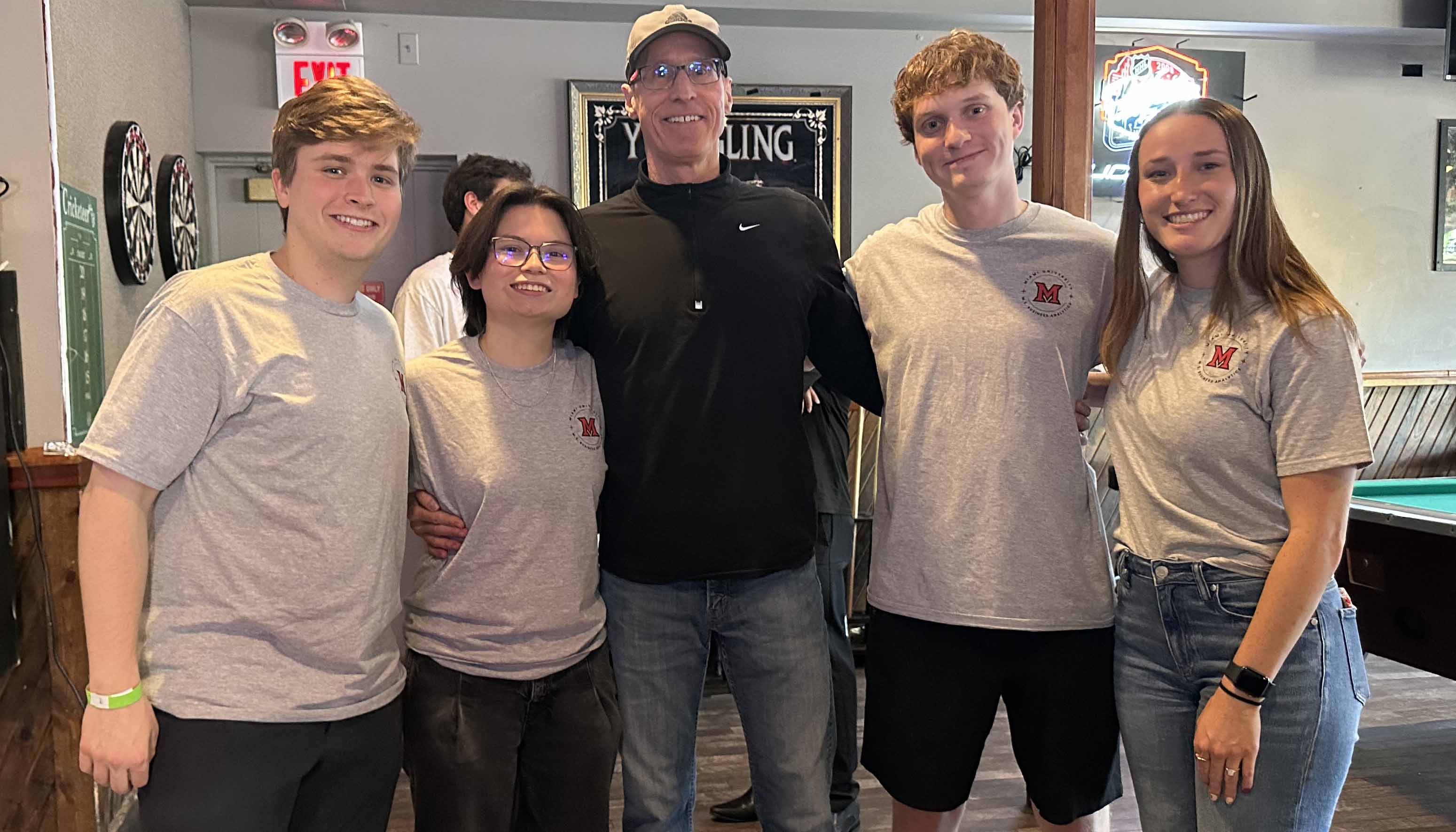
(L-R) Jack Julian, Kate Uhrick, Ryan Altic, and Heather Siudak with associate teaching professor Bill Myers (center)