
FSB alumni discuss the pathways to their supply chain careers
Trio talk about how they found their place in supply chain and how students might do the same
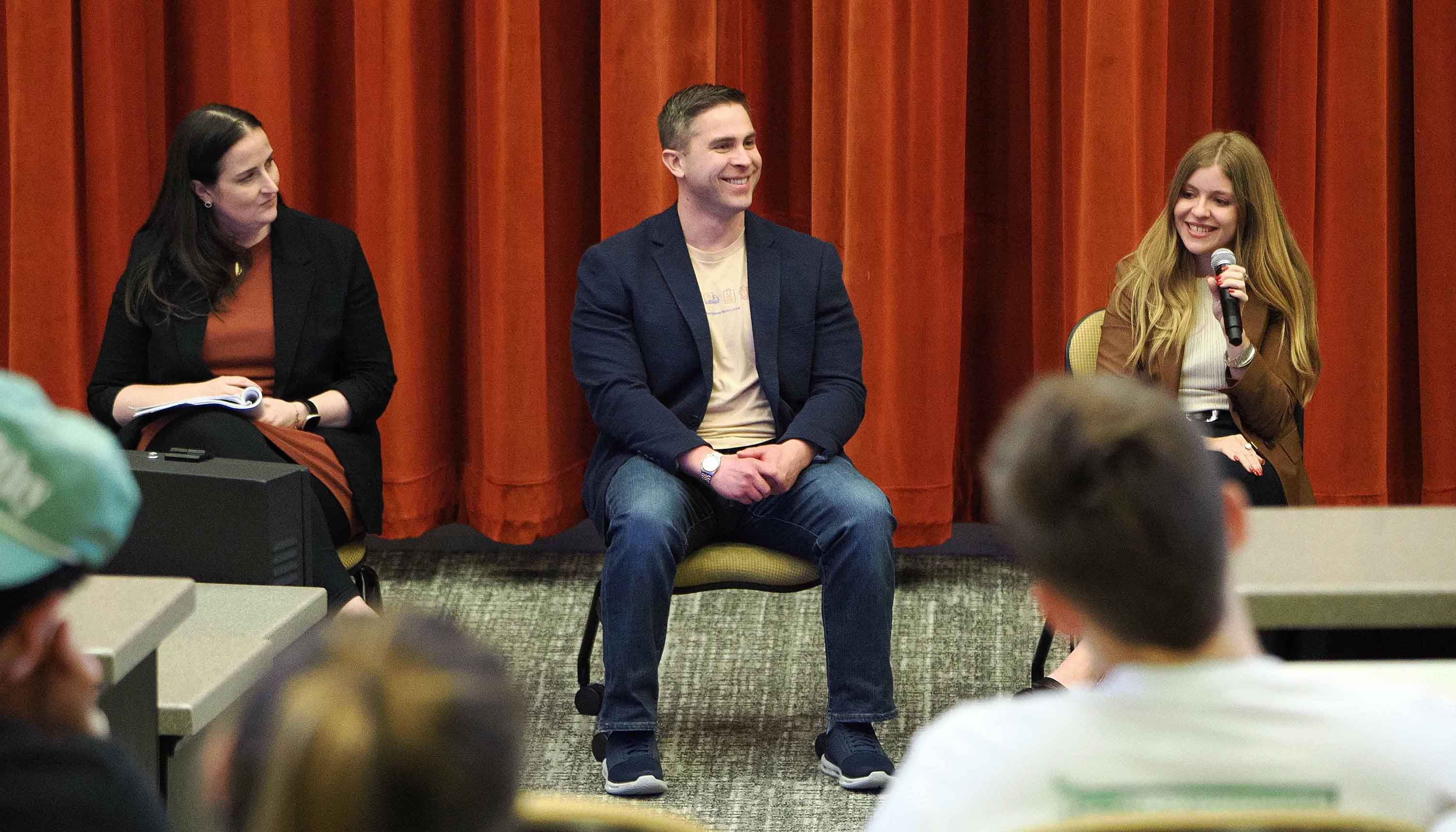
FSB alumni discuss the pathways to their supply chain careers
Trio talk about how they found their place in supply chain and how students might do the same
Seth Harms, Taylor McCallum, and Rachel Cleveland earned their degrees from the Farmer School of Business about five years apart, starting with Harms in 2008. They returned to FSB to talk to students about their careers in supply chain operations and management and the paths that brought them to where they are now.
“I have been with Procter and Gamble ever since I graduated, and that entire time, I've been doing supply chain related roles,” Harms said. “Started off working with our customers on customers’ logistics-related challenges, then moved more centrally into planning, and my last third or so of my career has been spent doing innovation.”
Cleveland got her degree in supply chain management, but started her career in consumer banking, then became a consultant, and now, just six years after graduation, is a vice president at Serent Capital. “I'm a team of one. I lead all our post-M&A execution,” she explained. “I think supply chain has probably given me the biggest leg up in the space, in that I can help translate processes and operations into things that make sense for our executives and help us make strategic business decisions.”
McCallum has a degree in electrical engineering, but got her MBA at Farmer in 2012 while working as a category supply planner at P&G. She’s now Executive Director of Brand Value Chain for the Origins brand at Estée Lauder.
“Previously, I was on the Clinique brand doing new product launches,” she said. “I’ve really enjoyed moving into this bigger scope across multiple different deliverables, coordinating demand planning as we think about the business plan and basic business brand operations.”
Harms said that he’s enjoyed his roles in supply chain because supply chain touches all aspects of a company. “In my current role, I'm an innovation director, and I am responsible for working for our general manager, and I will work with him on how do we and where do we think we need to grow? Where should we innovate? I'll work with research and development to figure out what new ideas do we have that we feel like we can bring to market. I work with sales and brand and figure out if we have brand and customers that can support this? And then I also am the bridge to our technical team to see how we can deliver this operationally,” he said.
“The baton drops between the silos so many times. So, you have to step in as supply chain because you're managing that bigger picture of getting a case to the door, getting a project out the door,” McCallum continued. “Because we're seeing it all and have kind of experience across the board, we're stepping in and saying, ‘Okay, we're stepping into this leadership void.’ I'm setting up a meeting, I'm taking the notes and driving the resolution, because ultimately, it's going to impact the brand, and particularly my KPIs, as far as delivering something out the door.”
Cleveland said that because her company invests in founder-led companies, change management is an important component and something that her supply chain experience helps her navigate.
“I think of almost every functional area or process that I touch is a little mini supply chain,” she said. “I try to use my supply chain background to be very thoughtful about the employee experience as part of the change in the transformation journey – and what happens to an employee. I kind of map out the employee journey, just as you would map out the supply chain journey for a product that's moving through a traditional supply chain ecosystem, and I think about the dependencies, the impacts, and the change management required to do it the right way.”
Asked what she would have done differently when she was younger, McCallum said she would have promoted herself more. “No one owns your career but you, and you have to drive that. You have to build your supporters, whether it's mentors or anyone else, and you have to be talking yourself up,” she said. “There are people who are doing less than you talking to their leadership and saying they're doing all this good work, and you're doing so much more, but you're not touting yourself. It was really hard it was for me, but you have to share your accomplishments, and you have to promote yourself.”
“I challenge everyone to remind yourselves that after you post about your new first job on LinkedIn, you are the person that has to show up and work that job every single day,” Cleveland advised. “When the reality hit me that I had to work it every day, and maybe it wasn't what I wanted to do, that became my reality for two years and two months. I learned a ton, and I don't regret making that career choice, but I would challenge everyone as you're evaluating what that first job is, you're the one that must sit in the seat every day and do it. Try to think about what you actually want out of your own professional growth, career and development.”
All three noted that establishing a personal brand, expectations of how and when you work, and taking time for your own life will pay dividends across the board.
“If I don't exercise at least five days a week, I will go insane. It is enormously therapeutic and just helps me. It helps me be a better at all the other things. Helps me be the be a better dad, husband, employee,” Harms said. “I know that about myself, and I also I've communicated that I need to go exercise, and everybody kind of understands that. So, it is okay to set reasonable guardrails for what you feel like you need in order to be the best person that that you can be.”
“Every two years, I've taken eight weeks off to pursue something I'm passionate about. During my very first sabbatical, when I was a consultant, I went and became a sommelier, I worked harvest out in Napa, I got forklift certified and threw the overalls on every day. And I found a love of wine,” Cleveland said. “But now that I'm coming into this next chapter of my career, I'm being asked to prioritize those different parts of my life so that I can show up in my personal life the same way that I've showed up in my professional life the last seven years. So, there are tradeoffs, and it's a constant balancing act.”
“The more you let the company impose on your time, the more they will impose on your time. Set those parameters early on in your career,” McCallum said. “It all comes down to your personal equity that you are delivering. As soon as you aren't delivering, that flexibility and that work life balance is going to come into question, and you're going to get push back for that. If you have those clarifying expectation meetings as you're starting a role, it helps to set things with your leadership.”