
Preparing students for an AI-shaped future
In a KEEN workshop last month, educators explored the habits of mind students will need most as technology advances
Preparing students for an AI-shaped future
In a KEEN workshop last month, educators explored the habits of mind students will need most as technology advances
As artificial intelligence reshapes how people learn, work, and solve problems, faculty and staff across Miami University are asking a critical and timely question: What habits of mind will students need most in a rapidly changing world?
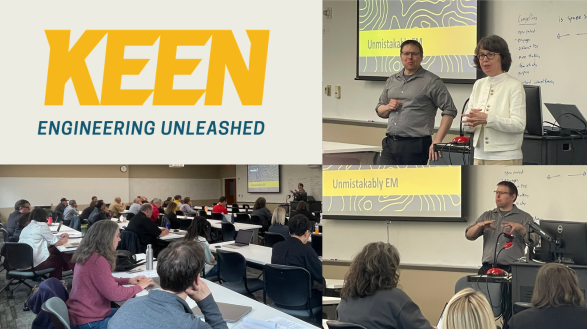
This question was at the center of a recent workshop hosted through Miami University’s connection to the Kern Entrepreneurial Engineering Network, or KEEN. The Crescendo workshop event brought faculty and staff from across the university together to explore entrepreneurial mindset, a way of thinking that helps students ask better questions, make meaningful connections, and create value for others.
Jessica Sparks, Associate Dean for Personnel and Curriculum at the College of Engineering and Computing (CEC), is one of the university leaders responsible for championing Miami’s participation as a KEEN Partner Institution, a membership which the university has maintained since 2022. Sparks worked with KEEN leadership to organize hosting the Crescendo workshop at Miami this year so that faculty from across the university could benefit.
For Sparks, this breadth of participation was paramount.
“We had people from all different divisions across the university, and it was exciting to see so many disciplines represented,” she said.
The May 1, 2026 workshop was led by A.L. Ranen McLanahan, Ph.D., Program Director for the Kern Family Foundation, who tailored the sessions for a broad university audience. While KEEN is rooted in engineering education, the ideas resonated well beyond engineering. That’s because they connect to goals shared by educators across disciplines.
Sarah Meaney, Director of the John W. Altman Institute for Entrepreneurship, said the workshop reinforced the broader relevance of entrepreneurial mindset at Miami.
“Attending the KEEN workshop reinforced my hope that the entrepreneurial mindset, which is so much bigger than starting a business, is taking hold at Miami,” she said. “This mindset is well positioned to advance our graduates into the uncertain future of AI.”
Participants could attend sessions on sparking curiosity, the science of human attention, and the habits of mind that support entrepreneurial mindset. Reflecting on his time on campus as facilitator of the workshop, McLanahan noted Miami University’s thoughtful and attentive approach to the student experience.
“During my visit,” he said, “I was treated to rich, substantive discussions on preparing students to navigate complexity and ambiguity throughout their careers. You can see why they call their faculty teacher-scholars."
That cross-disciplinary energy was also felt by participants from across the university.
“I love the KEEN framework because it shows the ‘curiosity, connections, and creating value’ mindset applies across the board, not just engineering or startups,” said Audra Morrison, Accreditation, Analytics, and Planning Manager for the Farmer School of Business. “The workshop was a fantastic reminder that we don’t have to build these things in silos. We’re sitting right next door to each other, and by sharing these frameworks, we can work together to build the next generation of critical thinkers and problem solvers.”
Todd Stuart, Associate Teaching Professor at Miami’s College of Creative Arts, said the workshop also resonated from a creative disciplines perspective.
“The workshop focused on teaching essential skills like curiosity, opportunity recognition, creative problem-solving, and managing risk. As an educator in this field, I found the workshop exceptionally valuable and thought-provoking.”
Making learning visible
The workshop came at a particularly important moment for Miami. In May, the Miami University Board of Trustees approved the Miami Integrated Learning Experience, or MILE, as the university’s new general education program. MILE will replace the Miami Plan for students entering Miami beginning in fall 2027.
MILE emphasizes applied professional skills, experiential learning, reflection, an ePortfolio, and a co-curricular transcript. According to Sparks, that structure creates an opportunity to help students make their learning visible over time. The entrepreneurial mindset championed by KEEN gives students a language for that reflection, helping them identify moments when they asked meaningful questions, connected ideas across experiences, persisted through uncertainty, or created value for others.
Geoff Zoeckler, associate lecturer of entrepreneurship at the Farmer School of Business, said the workshop highlighted the role intentional learning experiences can play in building beneficial habits of mind.
“The KEEN workshop reinforced how intentionally designed experiential learning can help our students develop the curiosity and resilience they will need throughout their careers,” he said.
Through MILE, and especially the ePortfolio, students will be asked to share not only what they learned, but how they learned it. Sparks believes this reflective capacity may become increasingly important as artificial intelligence changes the skills graduates need in the workplace.
“With AI and the way it’s disrupting everything, being able to articulate how you think and how you learn is possibly going to be as important as what you know,” Sparks said.
For Janelle Allen, a faculty member in Biological Sciences in the College of Liberal Arts and Applied Science, that reflective capacity also includes helping students think carefully about when and how to use emerging tools.
“A key habit of mind to finesse would be discernment of use,” she said. “Being able to discern the optimal use of artificial intelligence, both inside and outside of class.”
Prioritizing persistence
One habit that stood out during the workshop was persistence. As part of the event, participants reflected on which entrepreneurial mindset elements were most meaningful to them and which they most wanted for their students. In a survey conducted during the workshop, persistence (“maintaining a sense of agency and resilience in the face of obstacles and failures”) emerged as a top priority.
Sparks said this idea of persistence is especially important for students who may arrive at Miami after years of academic success and then encounter challenging, open-ended work that does not have an immediate or obvious answer. In a changing economy continually reshaped by emerging technology, students will need the confidence and resilience to keep learning new tools, solving new problems, and adapting to new expectations throughout their careers.
“We want them to think differently,” Sparks said. “It’s supposed to be messy. It’s supposed to be a challenge.”
Beena Sukumaran, the Dinesh and ILA Paliwal Dean of Miami University’s College of Engineering and Computing, echoed this sentiment after participating in the workshop herself.
“Seeing engineering and computer science faculty collaborating alongside colleagues from the humanities, business, and sciences reminded us that curiosity, persistence, and adaptable habits of mind are universal needs,” she said. “As AI continues to reshape the landscape, this collective, university-wide approach is exactly how we ensure our graduates are ready to lead and create meaningful value.”
Following the KEEN Crescendo workshop, Sparks said she hopes Miami can continue making KEEN-related professional development opportunities available across the university and build partnerships among faculty, staff, and academic units.
The goal is to help students leave Miami prepared not only with disciplinary knowledge, but with the curiosity, resilience, and adaptability to keep learning and growing throughout their careers.