
Friday, March 5, 4-11 p.m.
Social Innovation Weekend
Overview and Registration
 An immersive weekend experience where students come together to develop actionable solutions to real-world challenges related to food insecurity. Through brainstorming, testing ideas, and pitching innovative concepts, participants will explore the complex factors shaping food access and food systems in our communities. From food rescue and distribution to local agriculture, nutrition, and equitable access to healthy food, students will examine how different factors, such as education, economics, or infrastructure, contribute to food insecurity—and how innovative approaches can create meaningful change.
The weekend is organized as a client challenge, connecting student teams with community organizations and businesses actively working to address food insecurity. Each participating organization will bring a real challenge from its work, inviting students to explore the problem, engage with different perspectives, and develop creative, actionable solutions. Throughout the weekend, teams will collaborate with their client organizations and experienced mentors to refine their ideas and ultimately pitch their proposed solutions to the clients.
Sign up for Social Innovation Weekend:
- ESP 102 (CRN15921) registration deadline: March 5, 2027
Sign up for Social Innovation Weekend PLUS two additional meetings, one prior to the weekend and one reflection meeting with a different topic focus:
- Global Health focus - GHS202 (CRN15159) registration deadline: March 5th, 2027
SIW 2027 | Food Insecurity
Saturday, March 6, 8 a.m.-11 p.m.
Sunday, March 9, 8 a.m.-3 p.m.
A Weekend of Innovation, Collaboration, and Social Change
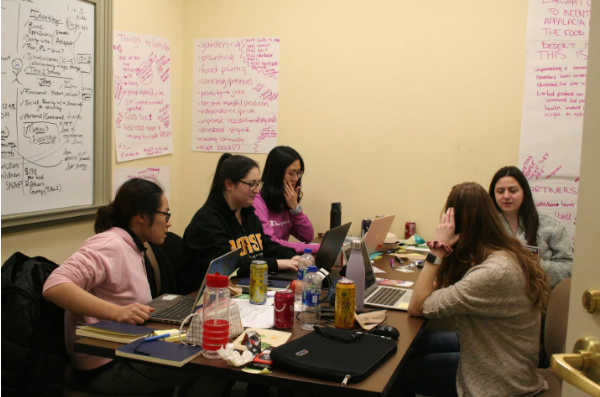
Over the course of this weekend, you’ll work in a team to address a real-world challenge related to food insecurity. Each team will be presented with a specific problem brought forward by a collaborating organization working to address food insecurity. With guidance from mentors, community leaders, and faculty, you’ll explore the challenge, develop an innovative solution, and pitch your ideas.
Plan to be present during the entire weekend.
- No prior experience in entrepreneurship is needed—just come with curiosity, creativity, and a willingness to collaborate!
- All majors welcome!
Be A Mentor!
Mentors are needed for Social Innovation Weekend to guide student teams as they develop innovative solutions to real-world challenges related to food insecurity. Working with collaborating community organizations and social enterprises, students will tackle specific challenges involving food access, food rescue and distribution, local food systems, and nutrition. Mentors will support teams in exploring these challenges, developing creative and actionable solutions, and translating their ideas into meaningful social impact.
Food Insecurity
Food insecurity isn’t just a lack of knowing where your next meal will come from; it is a symptom of broader injustices and structural inefficiencies. It reaches across many aspects of day-to-day life, such as education, nutrition, and infrastructure. Social Innovation Weekend 2027 allows students to partner with local organizations that are focused on all aspects of food security in order to develop client-specific solutions.
Food Access, Nutrition, and Services
Food access describes the process by which people can realistically access food physically and economically. According to the USDA, 18.3 million people struggled with food security in 2024. These families often have to prioritize price and convenience over nutrition, thus leading to malnutrition and other health complications.
This perspective invites exploration, critical thinking, and synthesis of how people are accessing food and the nutritional value of the food they eat. This area encourages those who want to explore nutrition, diets, health effects, and actionable steps for individuals.
Corporate and Chain-Based Food Systems
Describes the role of large-scale, standardized, and professionally managed food systems, including supermarkets, restaurant chains, institutional food services, and corporate distribution networks, in addressing food insecurity. Last year, Ohio's corporate and chain-based food systems donated about 105 million pounds of food to communities in need, while an estimated 70 million pounds still ended up in landfills.
This area invites exploration of the opportunities, challenges, and potential for innovation within corporate and chain-based food systems, including their relationships with communities, local organizations, and the broader food ecosystem.
Local Systems and Agriculture
Local food systems describes a collaborative network that integrates food production, processing, storage, distribution, and consumption within a defined region. Because it often relies on small-scale farms that lack the economies of scale and industrial infrastructure of large agribusinesses, its products often carry 15%-30% price premiums and remain uniquely vulnerable to local environmental conditions and regional policy shifts.
This area challenges students to look into where their food is coming from, and how they can help to come up with solutions towards more efficient production and sale of foods in order to improve efficiency in reducing these vulnerabilities.
Food Rescue and Distribution
Food rescue describes the practice of reducing food waste by distributing safe, otherwise unused food and allocating it to areas in need. According to the USDA, approximately 40% of the food supply in the USA goes to waste in some capacity yearly. Food waste costs the average family of four $56 a week in unused or discarded food.
This area invites exploration of the gaps, inefficiencies, and potential for innovation within food distribution and rescue systems, including how surplus food moves between producers, retailers, nonprofits, and the communities that need it most.
Contact Us
Farmer School of Business
Miami University
800 East High Street
Oxford, OH 45056
Dr. Anna-Katharina Lenz
Faculty Lead, Social Innovation Weekend
Email: lenza@MiamiOH.edu
Phone: 513-957-7038
Carol Olausen
Associate Director of Experiential Learning
Email: olauseca@MiamiOH.edu
Phone: 513-529-8528