
'I think we're going to do well' One team's journey through Social Innovation Weekend
Students from across Miami came together to identify problems and possible solutions around the topic of literacy
'I think we're going to do well' One team's journey through Social Innovation Weekend
Students from across Miami came together to identify problems and possible solutions around the topic of literacy
Laurel Logemann came to Social Innovation Weekend 2026 with an idea for a problem and possible solution for an issue in literacy, the topic of this year’s event.
Actually, she had two ideas.
“I originally pitched a different idea, to increase the Spanish education programs in elementary schools,” Logemann said. “But after talking with some other people in the area, I was like, ‘You know what? I'm more passionate about this.’”
Her second idea is to find a way to make crucial interactions between Spanish speakers and first responders more effective, one of many ideas put forth on Friday night. Social Innovation Weekend (SIW) is an immersive weekend experience where students work together to create actionable solutions to real-world challenges. Now in its ninth year, SIW students uncover how knowledge empowers communities, and with the support of experienced mentors, build skills, make connections, and turn ideas into meaningful impact.
After students pitch their ideas, they each pick up to three projects on which they’d be interested in working. The top-scoring projects are chosen, and teams form around each project. Once a team forms, they have until mid-morning Sunday to work on their problem and validate their solution before pitching it before judges.
Logemann’s idea is one of nine chosen.
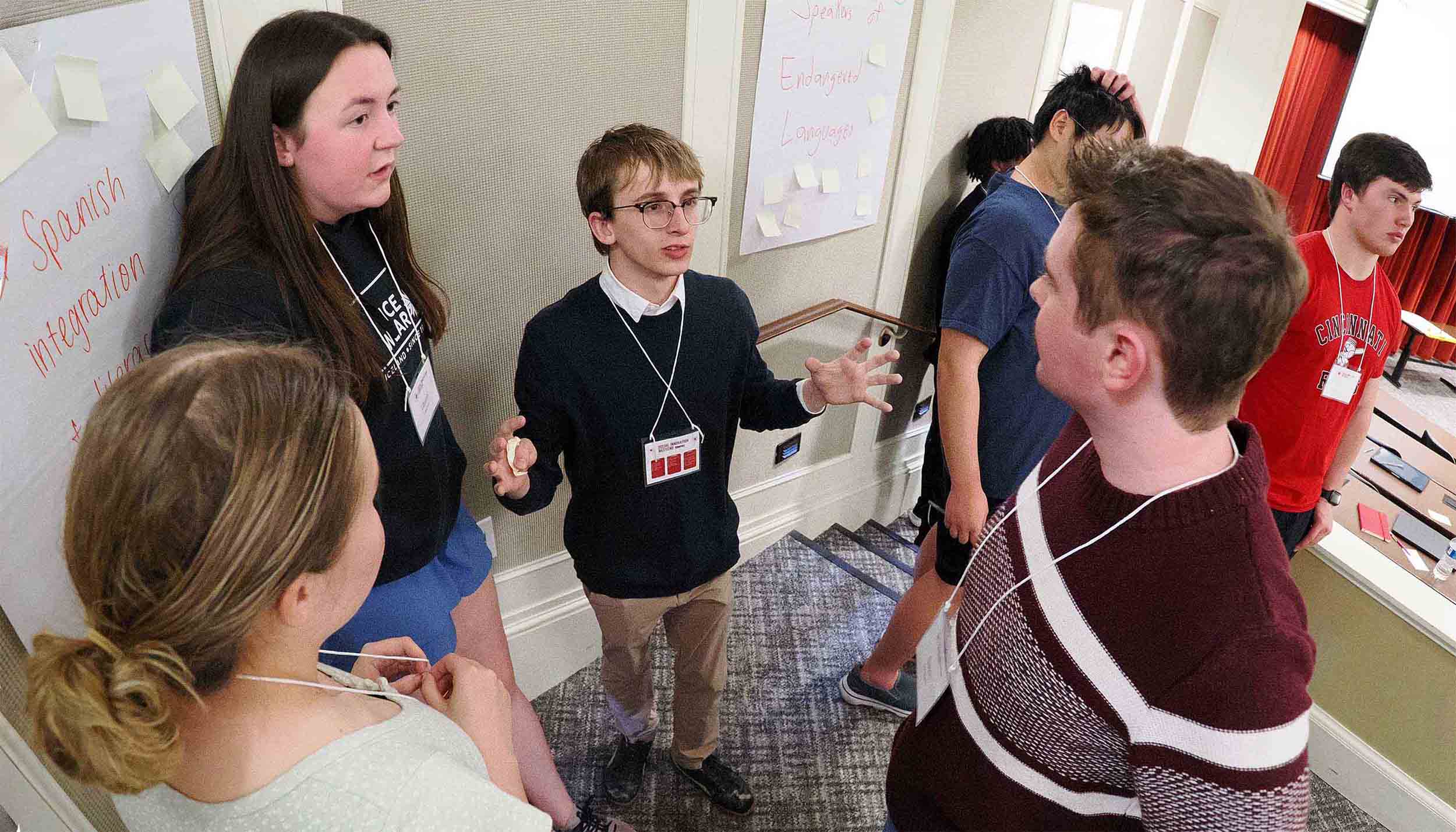
By 9 p.m., she has a team – Meena Sobie, Sean Spezzano, and Andrew Rutt – and a new “home” for the weekend in FSB classroom 0039.
“Let's talk about health, because there might be solutions to both ideas. I feel like the providers not understanding their patients is a problem,” Logemann says while settling in.
“And I feel like the current efforts, which are calls to a translator, aren’t real good,” Spezzano notes.
“Lack of immersion opportunities. We talked about this, one of the biggest challenges for English speakers learning Spanish in the U.S. is the lack of immersive environments,” Rutt says.
‘Correct me if I'm wrong, but healthcare workers don't have the opportunity to ever feel what it's like to receive lifesaving care in a language they do not understand?” Logemann replies.
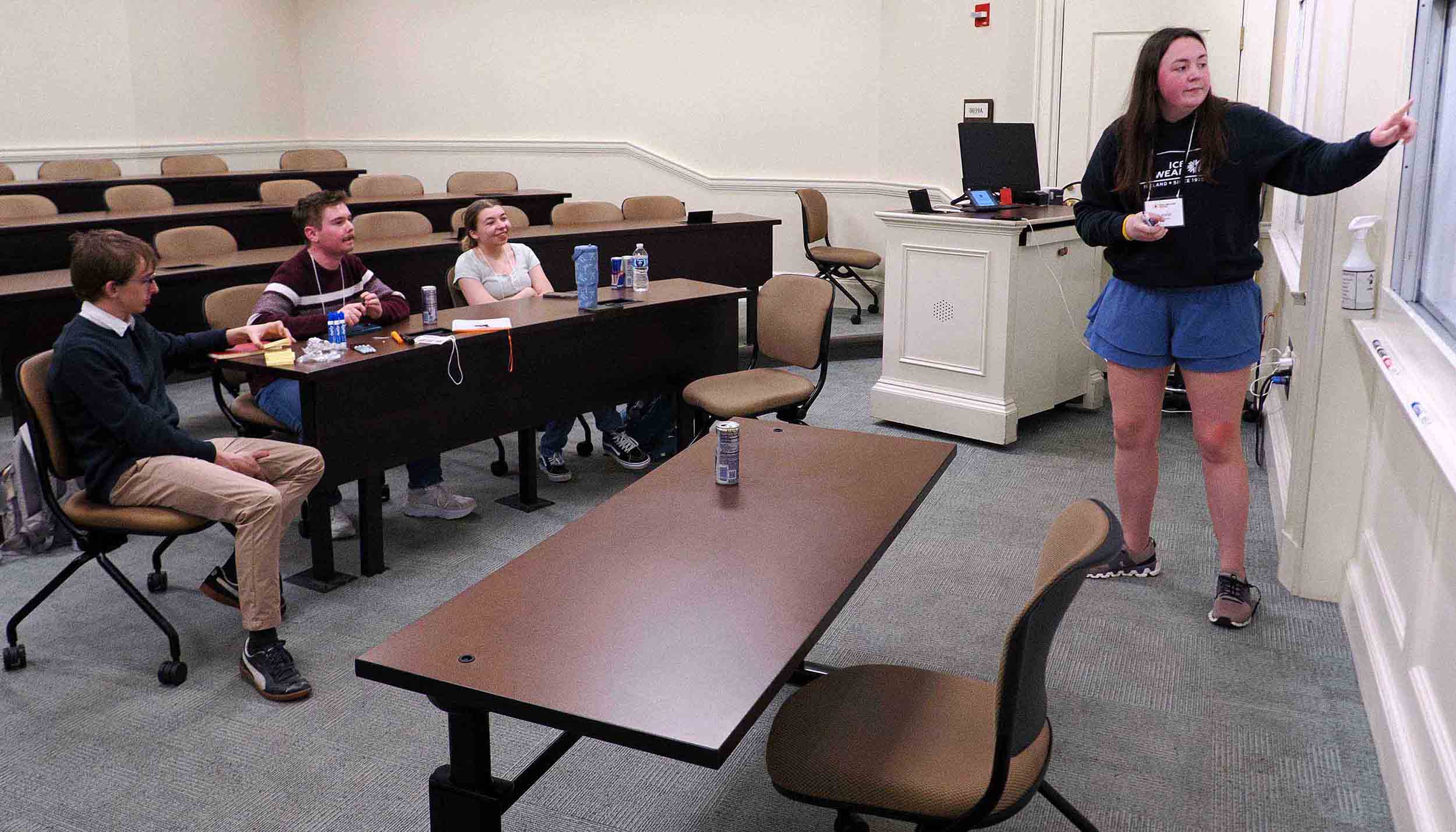
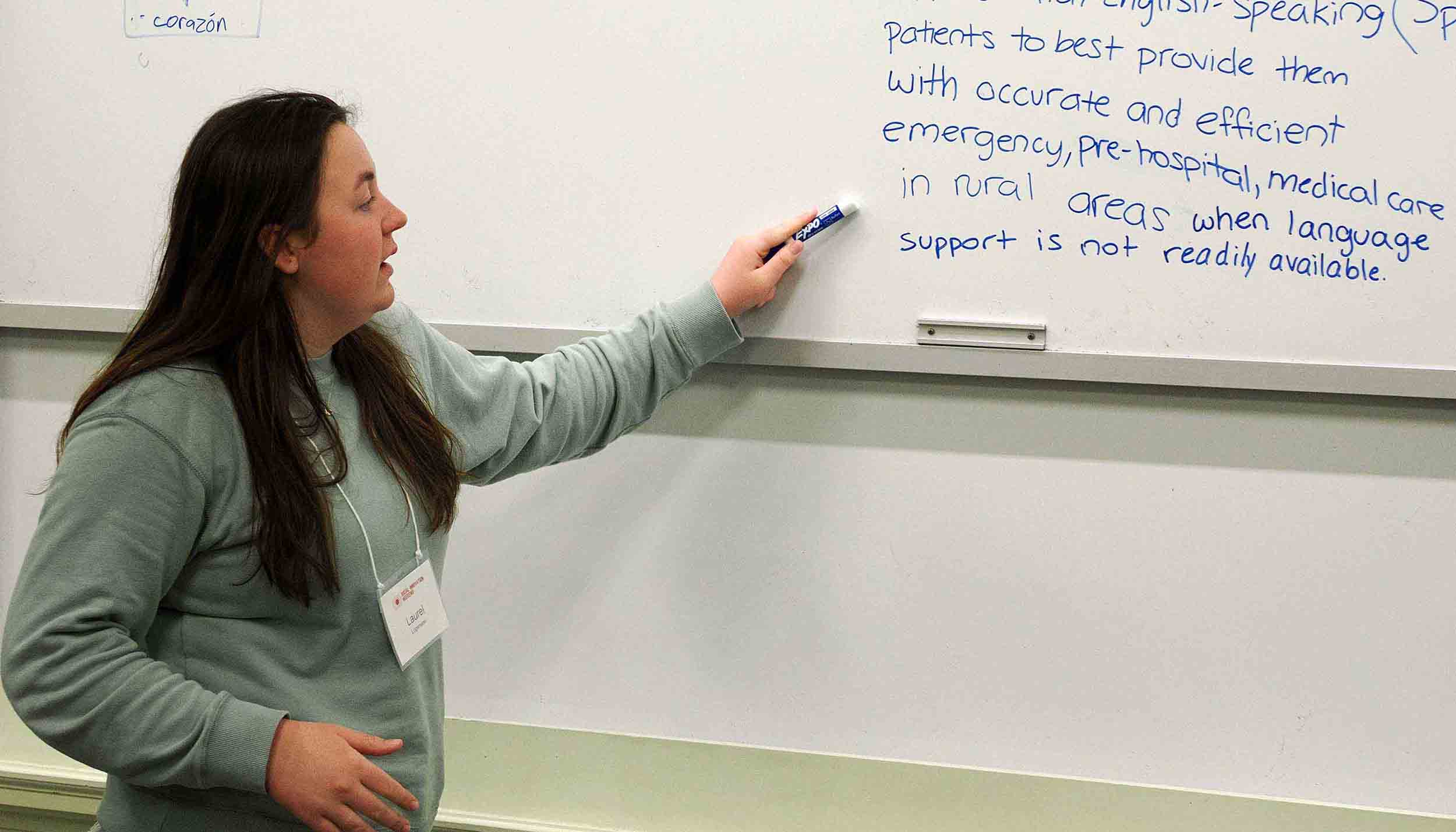
She begins writing on the whiteboard as the others talk. Within an hour, the first panel is full.
The topics for SIW change each year. Previous topics have ranged from loneliness/isolation to infant mortality to food insecurity. This year’s topic challenged participants to think broadly about literacy, from traditional skills to the ways people communicate, create, and connect in a changing world.
Creating a team on the fly and coming together to narrow a problem into something small enough to find a solution can be a daunting challenge.
“Start with your intuition, and then say ‘That was intuition. But now we have some things that we can think about. We think there's something there. I think there's interest. Now let's do some research. Let's go talk to some people,’” event director and Entrepreneurship professor Michael Conger says. “You're not just going by your gut the whole time, but if you just say, ‘We cannot move forward with any discussion until we have thoroughly researched this,’ you're just not going to go anywhere.”
At 8 a.m. Saturday, the team reassembles for breakfast in the Farmer School commons.
“Last night was good. It was very productive. I think we got a stronger idea of what we want to tackle in terms of our problem. We're going to start gearing ourselves towards emergency medical services and see what kind of struggles they have when it comes to working with only Spanish speakers and how we can help navigate that,” Logemann says.
“We were here till two in the morning. I'm exhausted, but I think it's a good exhausted, because we got a lot of work done. So, it's worth it,” she says.
Today’s first task? Find out more about the problem from the people most impacted by it.
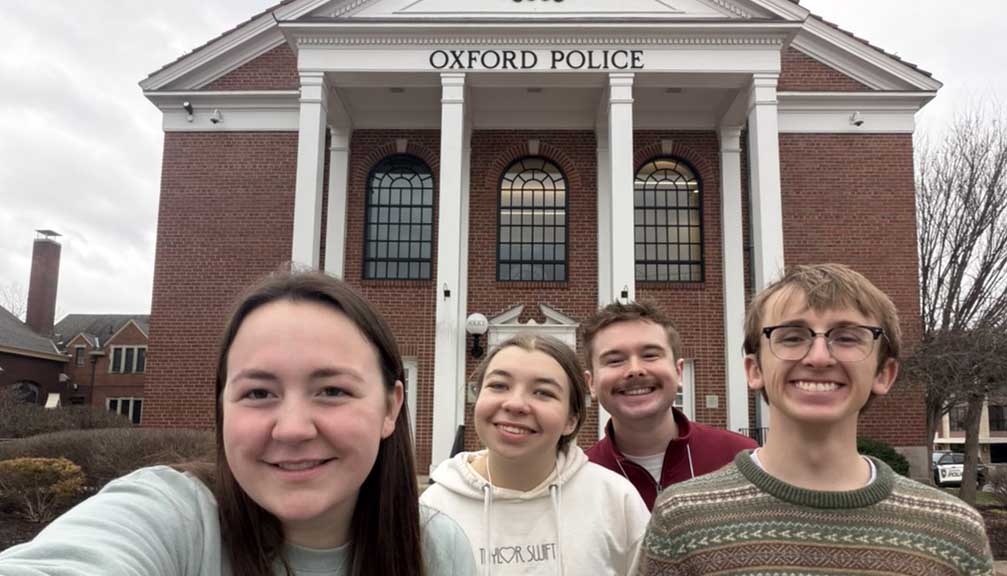
“We're going to the Oxford fire station, the Ross Township fire station, and then we're making a bunch of calls to first responders that we know to get their thoughts on this,” Logemann says. “Other than that, we'll see where the day takes us.”
Down the hall, Conger explains that Day 2 is critical for the teams involved because this is the time to validate that they are on the right track. “Friday is usually a big boost to energy, and today, reality is kind of setting in. What's usually happening is that they're realizing they must go and test some of this stuff that they've been thinking about,” he says. Maybe last night they had a lot of great ideas, and today they see that, ‘We’ve got to figure out if these ideas are right.’”
Saturday is also when mentors show up to give the participants the insight of their own knowledge and experiences. Some are Miami University faculty; others are alumni or local community and business leaders. Each has some expertise that might be helpful for the teams and their plans.
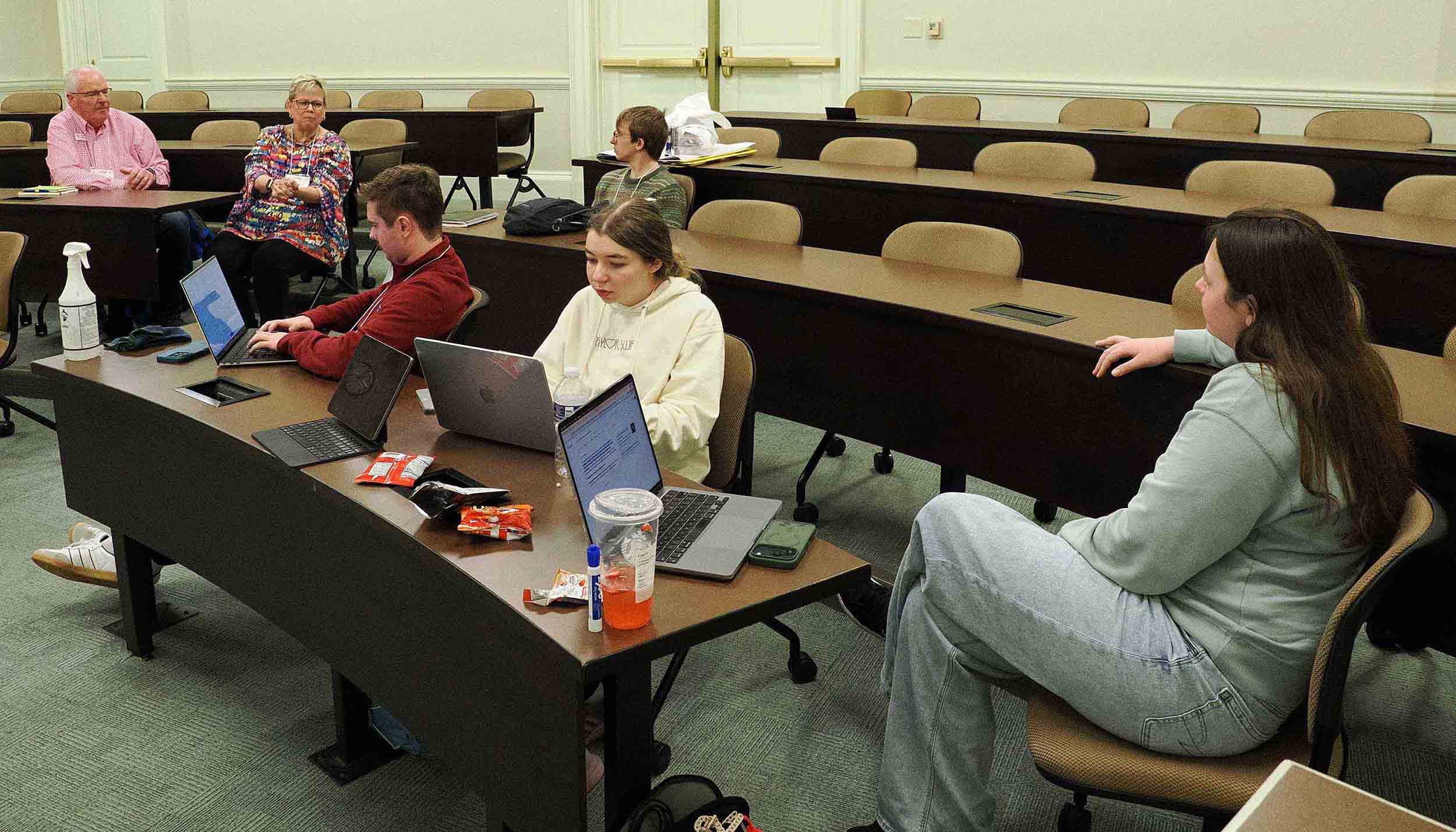
Saturday afternoon, Logemann and her team are visited by the Reibers. Kurt Reiber is CEO and President at the Freestore Foodbank in Cincinnati. His wife, Karen, is an educator with broad experience in integrating technology and promoting information literacy.
“So, you guys talked to first responders?” Kurt asks.
“We did. We first thought that it was going to be all first responders, police officers and firefighters and paramedics. But then we started to realize that the actual problem really lies within overcoming language barriers between the pickup of a patient to the drop off at the emergency room,” Logemann says. “So, we decided to only to focus on EMTs and paramedics.”
“They talked about when they pick up patients with heart conditions, and this person is saying, ‘My chest hurts.’ There are different types of pain that will indicate what they need to treat on the way to the hospital,” she says. “Is this crushing pain? Is this stabbing pain, shooting pain? Stuff like that is difficult to understand when there's a language barrier.”
“And hospitals are different, because they have people on staff. They’ve got somebody they can call, but that first responder, they don't have anyone,” Karen Reiber says.
“So, we were thinking of something like a communication card,” Logemann says.
“You could have a flip chart on a ring, but then somebody's got to flip through it. A tablet would obviously be the faster way to do it,” Karen Reiber responds.
“If you click on it, it might verbalize it. The tablet could verbalize something in that language,” Kurt Rieber adds.
“I can talk to my EMT friend and see to what extent he uses a tablet on a day-to-day basis,” Spezzano says.
By Saturday evening, teams are well on their way to a solution to their problem.
Or not.
“Some people are struggling because maybe things have not worked out the way that they thought, and they may be feeling like they can't get there, but they will. I'm confident they will,” Conger says.
“The point they're usually at right now is that they have their idea kind of locked down, or they're committed to an idea. They're committed to delivering something. And they are probably still trying to figure out if it will really work. Can we pay for it? Can we get the people and the equipment and access and all those partners, everything that we need?” he says. “Later tonight, they will start to put together how they will share this with other people in their pitch. So that's where people are, and it can feel great, and it can feel terrifying.”
By late Saturday, Logemann and her team have decided that a tablet isn’t going to be the best item to use for their solution.
“If a station has four ambulances, are they going to afford to put four brand new iPads into the ambulances?” Logemann asks. “I think that's why I'm kind of turning toward laminated paper, because it would cost us probably $10 to print and laminate these and distribute them.”
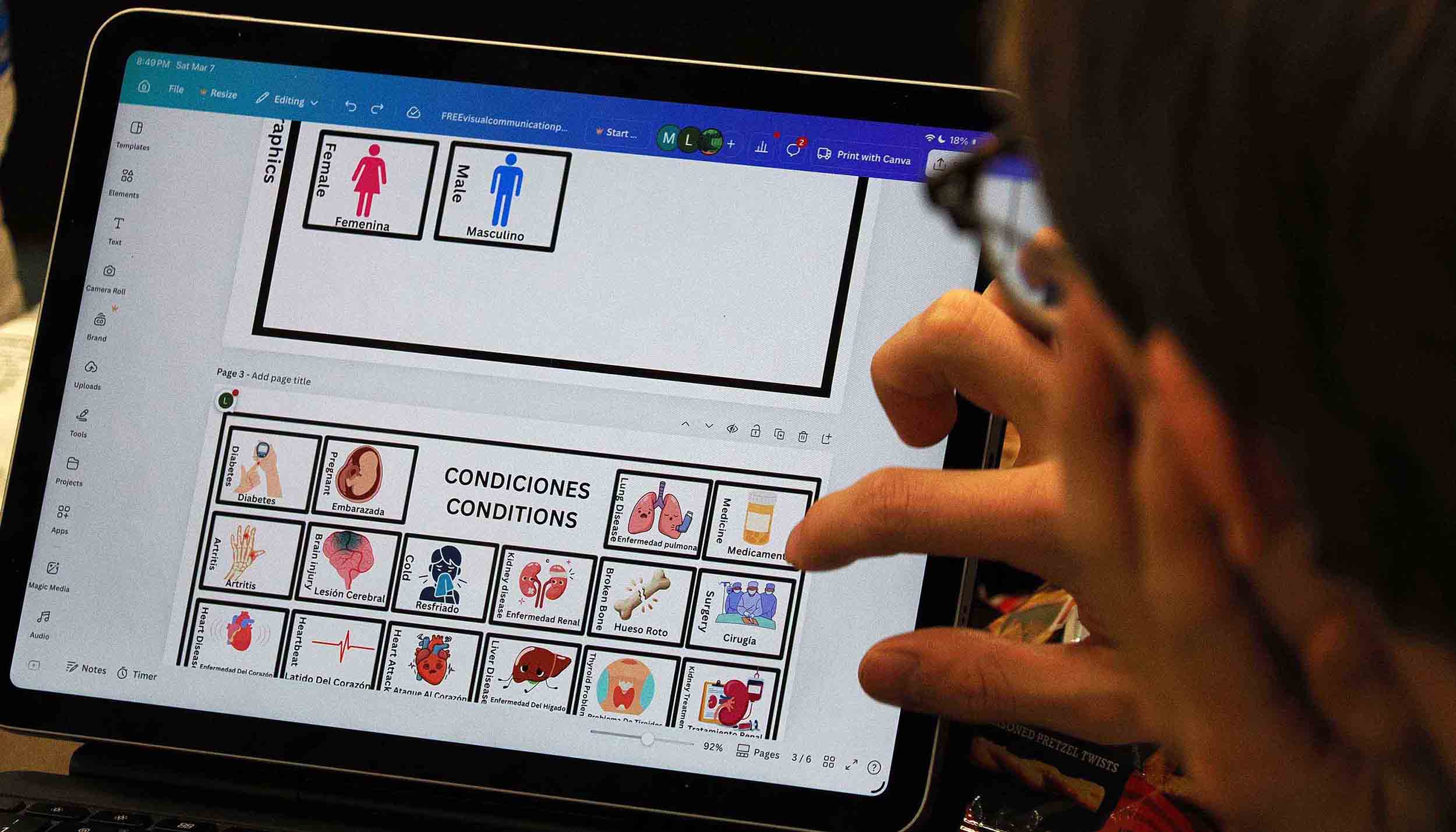
“I have an idea. I took three years of visual arts and design,” Sobie says. “I can do it quickly and print it out.”
“It’s essentially like conversation cards. A piece of paper that has the Spanish term, the English term, and a picture for each described word, and then as the pages go on, it helps the paramedic narrow down what the issue actually is,” Logemann explains.
On Sunday morning, teams start practicing their presentation talks, which take place at 11 a.m. Each team gets seven minutes to pitch, and then take three minutes of questions from the judges.
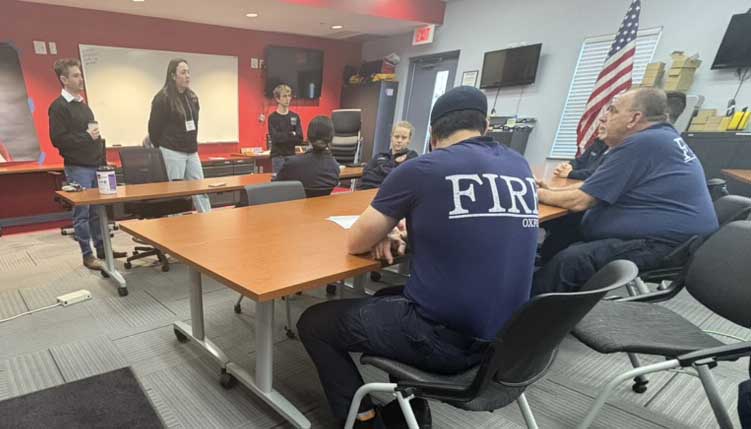
But Logemann and her team have taken their printed cards back to the Oxford Fire Department to get their thoughts about the final product. By the time they get back to the Farmer School, it’s only a little over 90 minutes until it’s time to present.
And their slide deck is due sooner than that.
“Can you change the font color for the references to white? It defaults to blue, and you can't see them,” Spezzano asks. “When I downloaded the PowerPoint it changed to blue.”
“It’s because the font isn't supported in our … Oh, my God. It looks terrible as a PowerPoint. Oh, my God, oh, my God. Our slides look so bad. I'm so glad you caught that,” Logemann replied.
After a moment’s thought, she says “I think we just do PDF, then they can make it clickable, because there's a clickable version of PDF.”
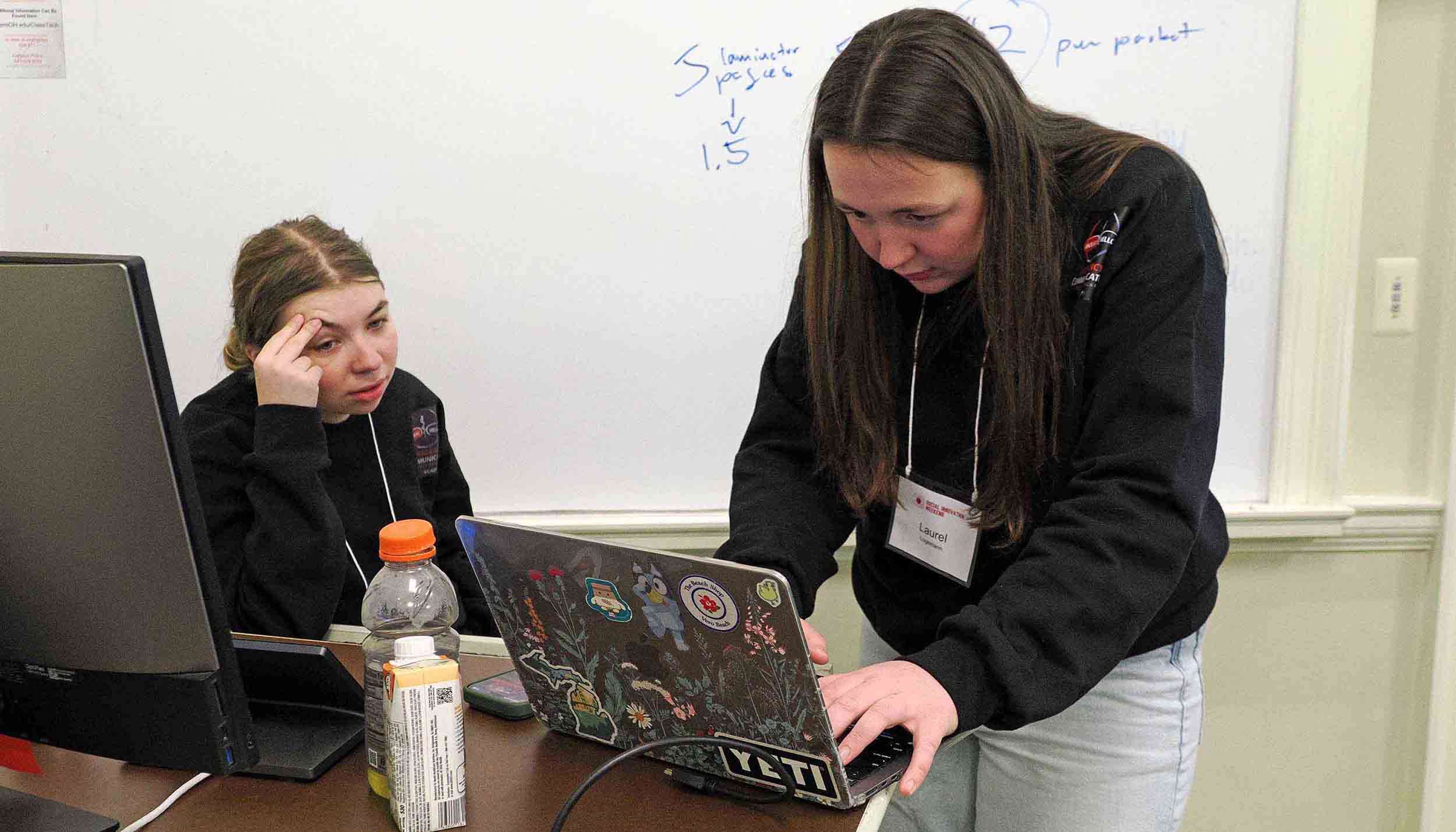
A few clicks, a couple of spelling corrections, and the slide deck is sent. The Emergency Communication Access Program team is ready to go.
“I feel like it always comes together in the last couple of minutes, because the weekend is so fast, but it's definitely nerve wracking,” Logemann says as the team walks to the auditorium. “You don't feel as prepared as you would when it's a project you've been working on for months.”
She pauses.
“I think we're going to do well.”
The ECAP team is the fourth of the nine teams to present, and their presentation starts off as planned.
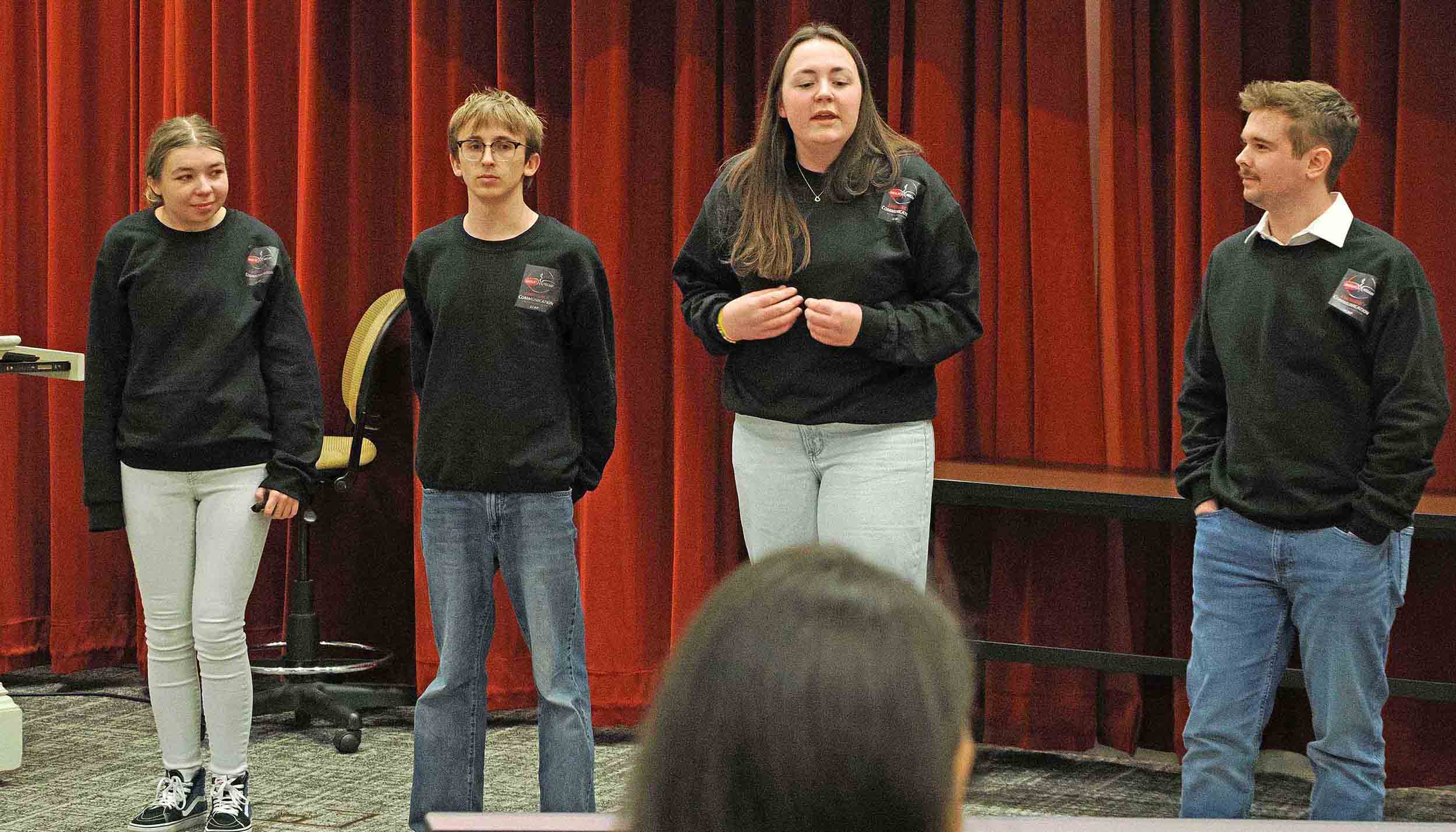
“Our goal as Emergency Communication Access Program is to assist EMTs and paramedics with communicating with their Spanish-only speaking patients,” Logemann tells the judges.
"Our total attainable market is the 800,000 EMTs and paramedics currently working in our country. Our sizable attainable market is the 450,000 EMTs and paramedics working with Spanish or Spanish speaking clients on a regular basis," Spazzano says.
“We found that paramedics currently have two systems of communicating with Spanish-speaking patients, both of which can be extremely inaccurate and inefficient,” Rutt explains.
A bit over halfway through their pitch, the timekeeper begins clapping. The team has exceeded their seven minutes, and they’ve been cut off. They haven’t had the chance to tell the judges some of their most important information.
But when the judges have their turn for questions, the first, Miami Anthropology chair and professor Cameron Hay-Rollins, asks if the team has validated their product.
“Yes!” Logemann replies, telling the judges about how they visited Oxford FD twice in two days and their reaction to their communication cards.
Another judge asks about cost, something else the team didn’t have time to discuss. By the time the question period ends, the ECAP team has managed to talk about most of the things they weren’t able to during the presentation.
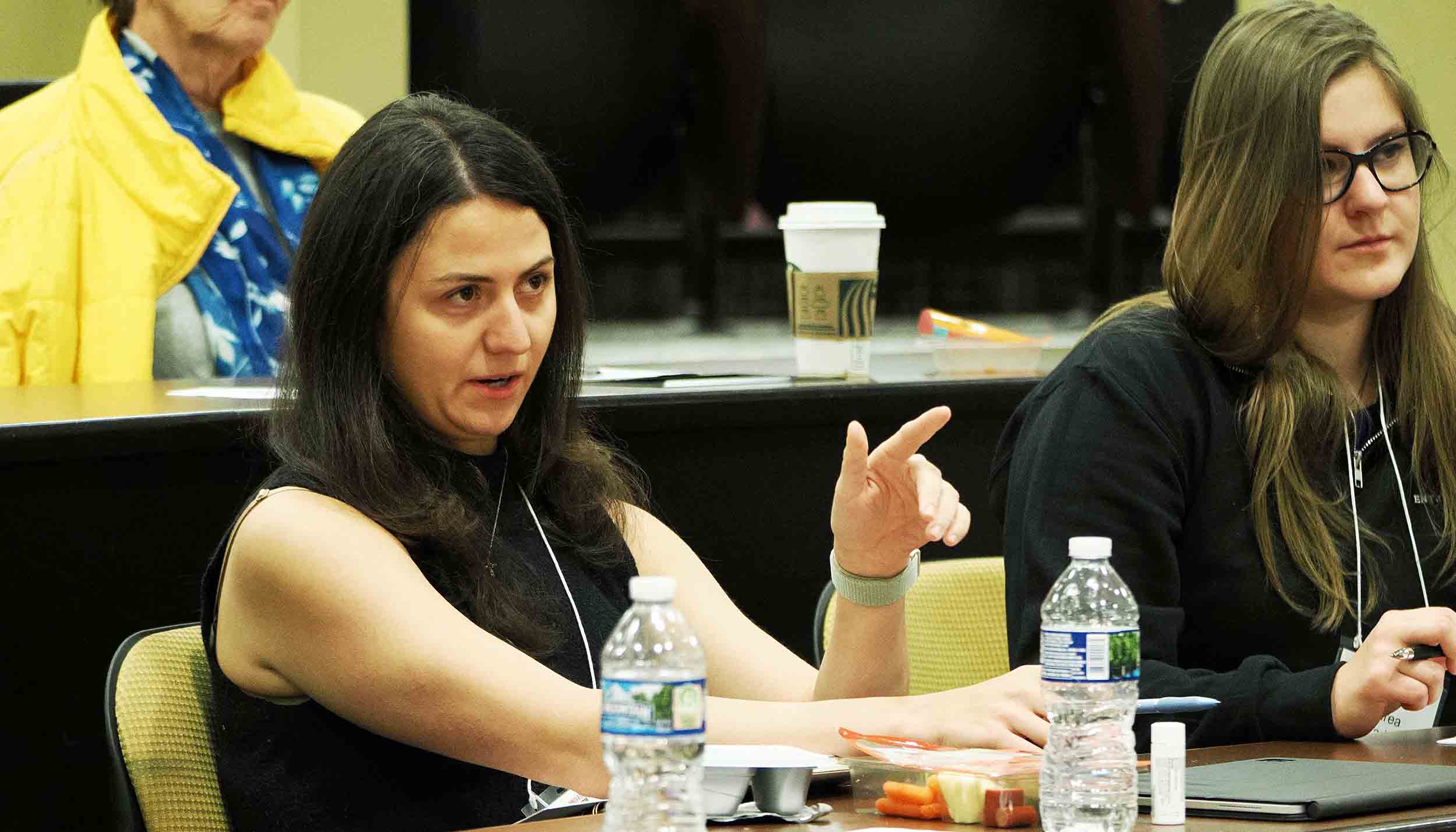
“Can I have one of these?” a judge asks as she holds up the cards.
“Absolutely,” Logemann says.
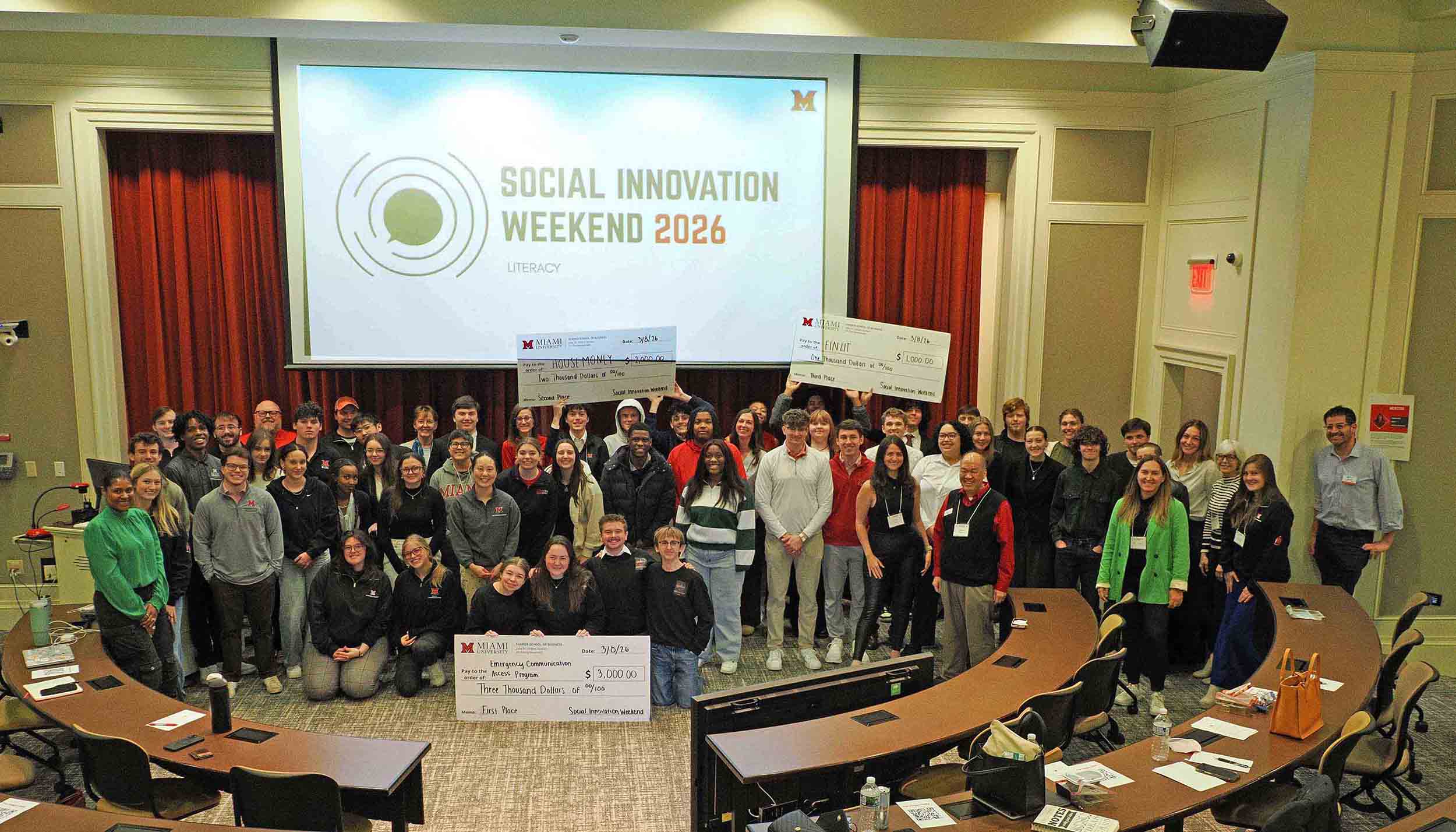
When the presentations are complete, the judges rank their top three winners while Conger talks to everyone. Entrepreneurship students in a side hall compile the results and write the winning teams’ names on oversize checks. First place receives $3,000, $2,000 for second place, and $1,000 for third.
And then, the announcements are made. In third place is FinLit, a program to help students and young people become more financially literate. Second place belongs to House Money, which is designed to educate and support students who may become addicted to online sports gambling.
First place goes to Emergency Communication Access Program.
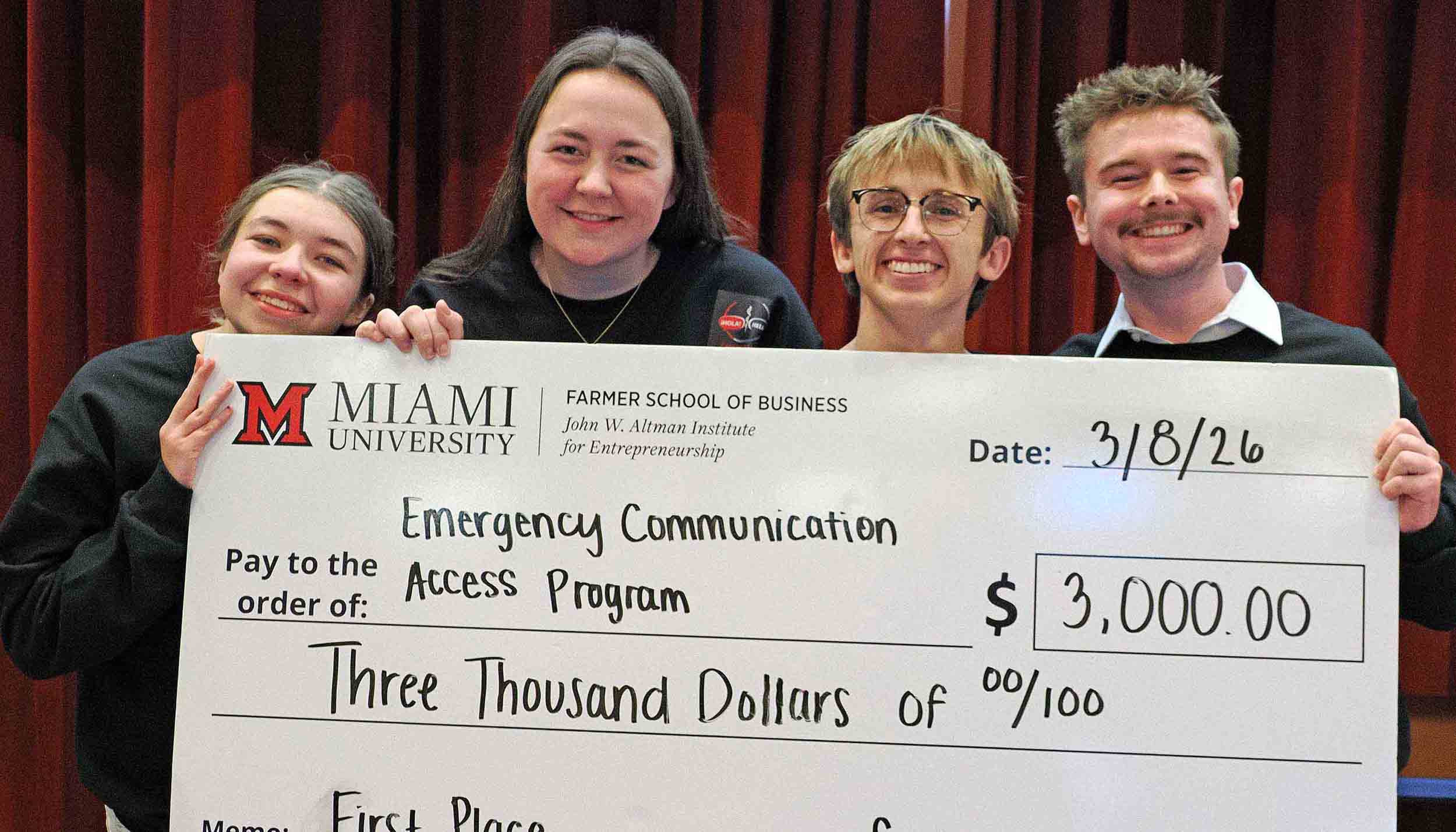
Applause, a group photo, and congratulations from judges, mentors, and other team members follow. Logemann gets a moment to think about what’s happened over the last two days.
“I’m so proud of my team. I think we worked really, really hard. We got like four hours of sleep this weekend” she says. “We really took a very intense approach, and it really paid off. I think your idea is just as good as your team. If you don't have a team that's passionate about the same things that you're passionate about, it's going to affect you.”
“I would love to continue it and maybe find ways that we can implement this or make it better.”
Across the room, Conger reflects on the future for all the teams taking part.
“We hope that we can find ways for them to push some of these ideas forward. How can we get help them get it going for the next week? The next month? How can we do help them take the next step?” he says. “But it’s also about starting your journey to doing this kind of work over the long haul. Who are the people I can talk to? What are the ways I want to grow? What are the things I want to learn? What are the skills I want to develop? If that's what people take away from this event, I think that's more important than which ideas get developed going forward.”