
New minor aims to develop leadership in students through humanities
A new College of Arts and Science minor is designed to help students further develop their leadership skills through learning key facets of the humanities
New minor aims to develop leadership in students through humanities
A new College of Arts and Science minor is designed to help students further develop their leadership skills through learning key facets of the humanities
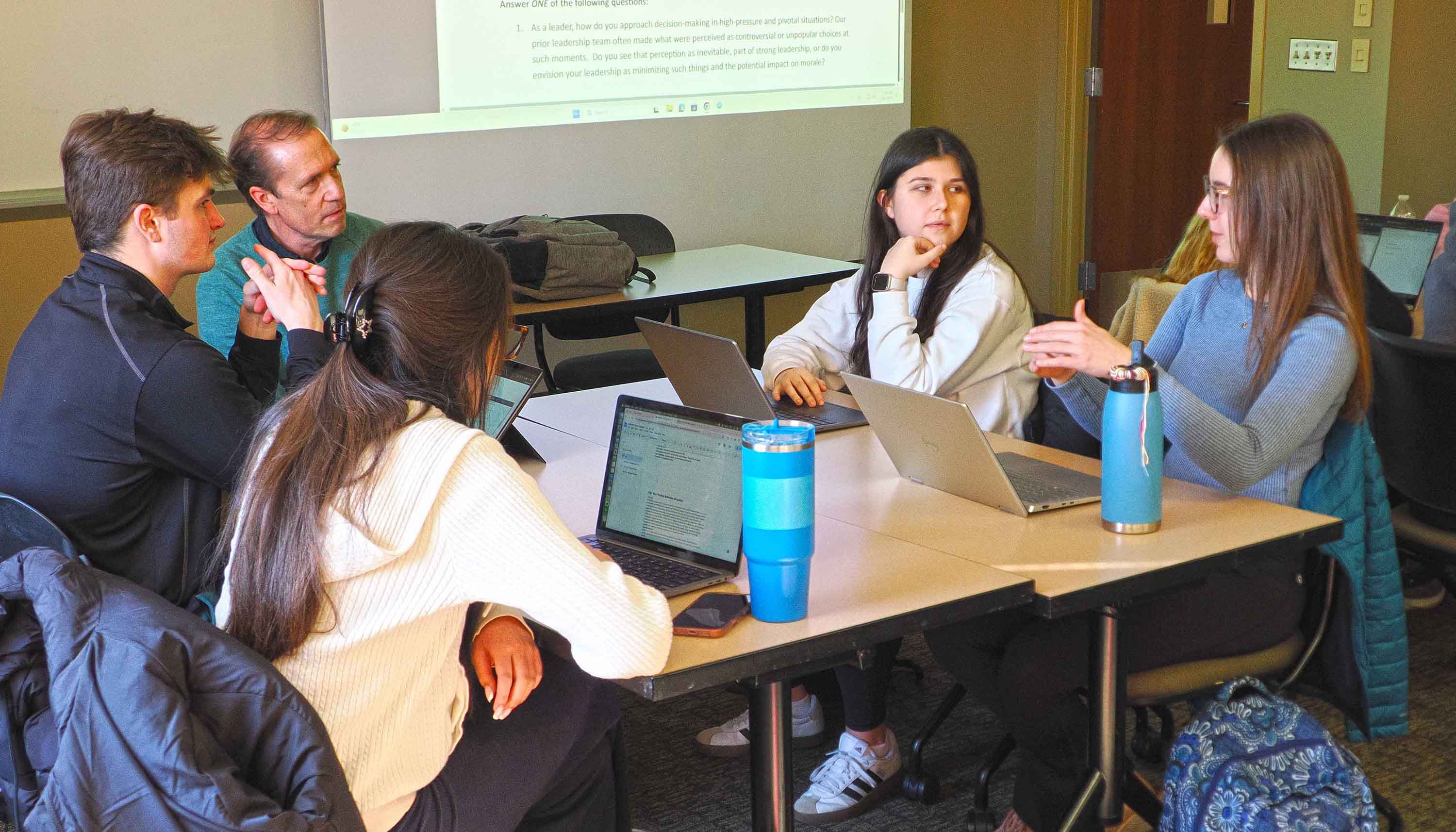
On the opposite side of the Miami University campus from the Farmer School of Business, in an upper-floor classroom in McGuffey Hall, more than 20 FSB students are part of a new class that itself is part of a new minor designed to use the humanities as a tool to improve leadership.
The class, HUM 151 Leading with Integrity, is the first of the College of Arts and Sciences’ new Humanities for Leadership minor. The minor is designed to cultivate leadership skills through historical perspective, ethics, communication, and empathy, in order to prepare students for complex leadership roles by grounding them in humanistic understanding.
But while the minor is in CAS, the impetus for its creation came from the Farmer School.
“What is it that the humanities do that's unique, that is helpful for developing your life, your life skills, your career? Everybody says critical thinking, but we do critical thinking in a particular way. So, what is that way? We broke it down into what we were calling integrity and empathy,” Associate Dean Gaile Pohlhaus explained. “Integrity is about figuring out what your own principles are, and whether you embody them or not. Empathy develops an ability to figure out what other people's guiding principles are, to understand how they experience and think about the world.”
Keith Fennen, teaching professor of Philosophy, is the instructor of the class this semester, but he developed the course in collaboration with Madelyn Detloff, professor of English and Global and Intercultural Studies, and Erik Jensen, associate professor of History, who will also teach the class in other semesters.
The collaboration allowed the professors to draw together some of the best lessons from history, literature, cultural studies, and philosophy for building integrity and empathy. “I think a lot of students came to the class just thinking it was about leadership. I told them, ‘Well, you can read all these books on leadership, that's fine. They're accessible. They're not rocket science,’” Fennen said. “The question is not just, 'How do I recognize the true statements in these books on leadership, but what do I need to know about myself and my principles that will allow me to embrace what these books convey?' This class is ultimately about leadership, but it works on the idea that leading anything with integrity requires first and foremost understanding yourself and others and leading your own life with empathy and integrity."
“Part of what's so interesting about this class being interdisciplinary – taught and designed by scholars across the humanities – is that the students themselves will be approaching the course not as English majors, history majors, or philosophy majors,” Detloff said. “For that reason, it will be helpful to have instructors who have expertise in one field, but also who will demonstrate what it is like to encounter some ideas as non-specialists who have very thoughtful and informed ideas about leading with integrity."
“What's happening in this class is teaching them how to pause from all their inertia, their professionalization, and just to figure out how to read something, have a conversation about it, and have it be meaningful and tied into their existence,” Fennen added.
Jensen said the goal of the minor is to give students a good understanding in human behavior, human diversity, and the richness of being human.
“We engage in deep reading because it's an important skill that needs to be cultivated. Exposing yourself to other disciplinary practices and ways and modes of thinking creates an agile brain,” he said. “I would love for my history majors to take a course on how to read a spreadsheet, or how to handle a supply chain, or even just understanding what a supply chain is, because I think that is equally valuable to the function of a good society.”
Megan Gerhardt, professor of Human Capital Management and Leadership, would agree.
“I think any opportunity our students have to bring different perspectives and be able to think more deeply about all of the factors that are involved in effective leadership, that's only a good thing,” she said.
Gerhardt noted that if we truly believe that leadership is about understanding people and having judgment, then the humanities are probably the thing we need to double down on right now.
“As a leader, you're always looking at all of the factors that you have to think about in terms of making the right decision,” she said. “I think there's a lot of self-awareness involved in leadership. I think there's a lot of critical thinking involved in leadership. And I think we're at a time now when as technology is rapidly and sort of chaotically increasing, it paradoxically increases the need for the deep human element, which I think humanities does better than anyone.”